
How to support someone you love
(without the battle)
How to support someone you love (without the battle)
It isn’t easy walking on eggshells. We provide the science and strategy
to help you replace conflict with connection.
It isn’t easy walking on eggshells. We provide the science and strategy to help you replace conflict with a new perspective.
How can I help someone who drinks too much?
Why this feels so hard
If you’re here, you’ve likely spent months, maybe years, trying to find the right moment and the right words.
Trying to help without making things worse.
Trying to speak up without triggering another argument.
You may be carrying more than you let on.
You may have seen effort.
You may have seen setbacks.
You may have felt hopeful one week and exhausted the next.
Over time, conversations can start to feel circular. Fragile. Repetitive.
That isn’t because you don’t care enough.
And it isn’t because they don’t.
When alcohol becomes embedded in how someone regulates stress, emotion, or relief, the dynamic changes.
What looks like resistance or indifference is often something deeper.
Alcohol use disorder isn’t simply a pattern of poor choices. It alters how the brain prioritises reward and relief.
If the behaviour feels confusing, inconsistent, or hard to reason with, there’s a reason for that.
And understanding that reason changes where the conversation begins.
Bruce explains the neurological drivers behind alcohol dependency, and how reducing craving while retraining the brain,
supported by structured guidance, allows change to unfold sustainably.

If this feels different, it’s because we’re approaching the problem differently.
When our understanding of the brain evolves, the way we apply that understanding must evolve too.
We’ve updated the Education...
...Why haven’t we updated the Application?
We are more aware than ever that Alcohol Use Disorder is a neurological disorder - a physical hijack of the brain’s reward system. Yet, as a society, our approach hasn't changed. We still treat those struggling as if they have a "willpower" issue or simply aren't trying hard enough.
This is why things feel so stuck.
When we treat a medical condition with a moral argument, nobody wins. You’ve likely felt the frustration of watching someone you love put alcohol above everything else. But they aren’t choosing the drink over you; they are struggling with an "Operating System" that has been rewired to prioritise it.
We have decades of neuroscience and medical research.
The real question is whether we’re using it in a way that truly helps the person in front of us.
At Rethink Drink, we apply that understanding in real life.
We treat the neurological reality with a neurological solution, so families can step out of conflict and back into connection.
How To Start The Conversation
One of the hardest parts of this journey is knowing how to talk about it without causing defensiveness. When you understand the science, you can stop talking about "willpower" and start talking about "solutions".
Three Ways to Reframe the Dialogue:
Move from "Why can’t you stop?" to "I’ve learned why it’s so hard to stop." Explain that you now understand the biological hijack in the brain's reward system.
Focus on the "Off-Switch," not the "Problem." Mention that you’ve found a method focused on restoring the brain's natural ability to feel indifferent toward alcohol.
Invite a "Look," not a "Commitment." Instead of asking them to quit today, ask them to watch the 10-minute video with you to see if the logic makes sense.
Get The Family Support Guide
Sign up below to receive our dedicated Friends & Family Resource Pack. This includes a summary of the 10-minute video, a deeper dive into the science of the Sinclair Method, and ongoing support through our Sunday Reset.
Why join the Friends & Family list?
Ongoing Education: Receive weekly insights designed specifically for those supporting a loved one.
Unlearn the Myths: We help you navigate the transition from "abstinence-only" thinking to evidence-based recovery.
A New Community: Join others who are choosing logic over judgment to heal their families.
Don't want to join the Sunday Reset?

Hear from Hayley,
sharing her experience as a partner:
Alcohol always felt like a second wife I never asked for.
I was so sceptical. I thought, “Here we go again, another new thing…”
Now he’s back to being my PJ, the man I married.
No triggers. No drama. No walking on eggshells.
Rethink Drink review from the wife of a client
Here's things from my perspective, PJ and me have been together for 16 years and drink has always been there.
It's been like a second wife I didn't want or sign up for. (in fact maybe more like a second husband I didn’t invite to the wedding because there was ‘my PJ’ and then ‘drunk PJ’ and those guys were very different)
He never drank in the house but he often disappeared and would turn up days later, often skint, very hungover, full of promises and apologies, until even they stopped
So, we started Rethink Drink, I say we because it felt like that sort of, but not really, I know it was really PJ that signed up for it
I was super sceptical and thought ‘here we go trying a new thing but this guy Matt seems to know what he's talking about and he's tried the same things PJ's tried and this worked for him’ (PJ tried cold turkey, AA - which I think is weird because the first thing you do is say your name so how is that anonymous? and even got tablets from the doctor that later turned out to be just vitamin tablets.
To be honest, I'm not sure all the things PJ tried but none of them worked - maybe for a short time but not long term
So back to Rethink Drink:
PJ was focussed this time - I’ve seen that before
PJ said it was going to work - I've heard that before
But give it a chance, we haven’t tried this yet, you never know, right?
I know there's more out there for PJ, I know he's capable of bigger and better things (more than just getting pissed)

"it has literally changed my life and my marriage"
I'll be honest, I was a bit disappointed when Matt said we'll just keep going to set the level (he put it way better than that)
but like what? Are you serious?
PJ is now encouraged to drink?
Isn't that the opposite of what we're supposed to be doing?? I wanted to PJ to stop drinking full stop – none of this manage it stuff.
But Matt encouraged me too, explaining anything and everything, whenever I had a question, Matt was there. (I don’t mean like 3am and I’m calling him for a chat or anything stupid but there was never anything off the table to ask and he always got back to me)
And so, we got going.
One of the early suggestions was ‘let's try drinking in the house’. At this point I was like great now I’m going to have to deal with him drunk in the house and watch him do it, but ok let’s try, what else have we got to lose?
But all of a sudden PJ getting 'drunk' wasn't an issue anymore. WTF?
I don’t even mean for him, like for me it was a trigger (I don't wanna sound like a snowflake but it's true)
Every time PJ would go out I'd be pacing the house unable to settle because, you know, he's going to come home and be all in your face and loud and just ‘drunk PJ’ (a bit of a gobshite not an aggressive drunk but still quite irritating, loved to start an argument and hard to deal with)
Anyway that went, away again WTF?
And it went away pretty quickly, although to be honest we had a shit tonne going on at the time so I didn't pay attention to when that stopped (sorry for being unhelpful and spoiler alert, expect that it’ll be ‘different for everyone’ because it is)
This was all happening at a time when our family was going through one of the hardest and more stressful things we’ve ever gone through and all of a sudden PJ’s drinking was no longer an issue
So where are we now? I honestly couldn't give a rat’s ass if PJ has a drink or not, I don't even ask anymore. If it seems like he's going to be out later I just leave the door unlocked (don't burgle me I’m poor) and leave him to just come in whenever, feeling rough the next day? sick bowl it is and my super duper hang over cure that’s actually awful, but kind of satisfying for some slight wife revenge (recipe available on request – you’re welcome)
There's no trigger at all for me now
And PJ? he's much more settled, seems to be excited about the future and been making plans. He's not the angry pissed off guy that he was14 (yes just 14!!) weeks ago, that hid in the pub and sulked a bit, made promises he couldn’t keep and then kicked himself for not keeping them. He’s back to getting excited about stuff and working on revamping old projects and working on new ones. He’s back to being my PJ – the guy I married
We've got a lot closer (I could go into detail but trust me you don’t want me to – let’s just say intimacy is easier and a lot more enjoyable – I’ve said too much already) and it's much easier to share stuff that might've been a bit uncomfortable before. We’re more open with each other because there’s not that looming worry that it might upset him or piss him off and he’ll go to the pub. The friction has gone. To me it feels like we're rock solid and ready for the next drama (and this time it won't be booze related - I don't think it ever will be again)
I’m so proud of PJ for how he’s done with Rethink Drink but it’s more than just what it’s done for him. I see the change with me too. I feel like a broken record but there’s no issues, no worries, no triggers with alcohol anymore, now I just get to complain at PJ about the normal wife stuff like ‘why can you never find anything?’
So basically if you're not sure, on the fence, will it work?, all that shit - just go for it. It's worth it (and no one pays me to say this stuff, I do it for free!)
Are you a wife, suspicious that this dodgy new guy on the internet is encouraging your alcoholic man to drink?
Don't sweat it - it's part of the process, just give him (your man) the space and support to go through this, you'll be thanking him and Matt later
Honestly I'm delighted that I get to write a review for this because it has literally changed my life and my marriage, not just PJ, not just drink
I guess to sum it up I’d ask you: how would it feel to not give a rats ass if your partner drank again or not?
If the answer to that is: it would be awful and he has to stop drinking now, then encourage your partner to keep going to AA and cross your fingers
If the answer is: that would be awesome, hit up Matt in a DM, trust me it’s worth it – this man knows what he’s talking about, it does work, he’s been through it himself and it won’t just change a relationship with alcohol.
The short version:
Rethink Drink didn’t just change how he drinks… it changed everything.
No triggers. No drama. No walking on eggshells.
Just my PJ back, our marriage stronger, and me finally free to moan about the usual wife stuff again.
If you’re on the fence - jump. It’s worth it.
Yes, he drinks sometimes. No, I don’t care anymore.
And no; Matt didn’t pay me to say this. (But I wouldn’t say no to a decent box of teabags, mate. My favourite is Yorkshire tea – just saying)
Matt's Experience
Getting alcohol under control changes more than drinking.
This video was recorded by our co-founder Matt during his own journey.
He shares the real impact alcohol was having at home, and what changed when everything was finally put on the table.
We are here for them, and we are here for you, too
Change rarely happens in isolation...
So when someone begins to change their relationship with alcohol, it isn’t just their journey that adjusts.
The environment around them adjusts too.
That’s why we don’t just work with those struggling.
We've created a space for partners, parents, and close family members to understand what’s happening, to ask questions, and to steady themselves without becoming responsible for someone else’s progress.
Sometimes that looks like dedicated family sessions.
Sometimes it means joining part of a 1-2-1 call.
Sometimes it simply means having clarity about what this process is, and what it isn’t.
What it never means is carrying the work for someone else.
Change has to come from them.
But understanding changes the environment around that change.
And environment matters.
A Deeper Guide for Families
If you recognise the tension, the conversations that go in circles…
I wrote something for you.
Supporting A Loved One:
A Guide for Friends and Family When Alcohol Is a Problem
This isn’t a book about convincing someone to stop.
It isn’t about ultimatums.
And it isn’t about carrying the weight alone.
It explains:
• Why conversations about alcohol so often backfire
• Why pressure and logic can unintentionally increase defensiveness
• What changes when alcohol is understood as a neurological condition
• The difference between support and control
• What early progress actually looks like
• How to protect your own wellbeing in the process
For partners, parents, and close family members who are trying to care without losing themselves.
There is no sales pitch inside it.
No pressure to decide anything.
Just perspective, clarity, and a calmer way to think about change.
You can download it free below - I hope it helps.
Matt
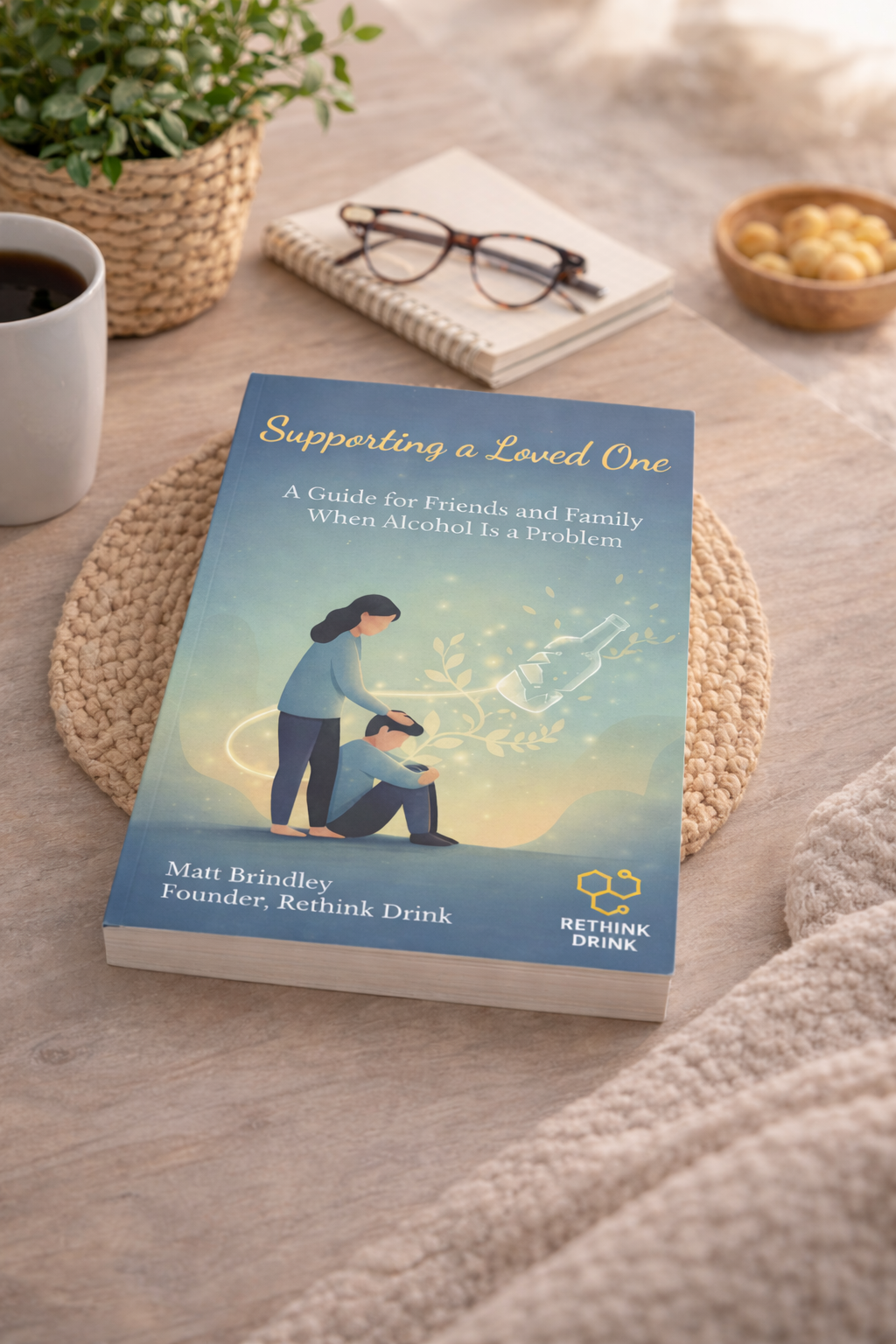
I wrote this because my wife once stood exactly where you might be standing now.
I wish she’d had something like this back then.
If you’re considering what comes next…
Everyone starts in a different place.
What matters is taking the next step that fits your situation
Just Starting Research?
Discover The Sinclair Method in our free mini-course. Start today.
Need to talk it through?
Get your questions answered by one of our Experts.
Ready For Change?
Explore our programmes.
See the options.
Don't want to join the Sunday Reset?
As seen in:


Copyright Rethink Drink Ltd 2023-2026 | Company Registration Number 14619896
The Sinclair Method in the UK | Privacy Policy | FAQ | Free UK Alcohol Units Calculator | What is the Sinclair Method? | Login
Registered Partner Pharmacy: Porter Pharmacy Braehead, GPHC Registration Number- 9011388 | Andy Porter, MRPharmS Superintendent Pharmacist