
What Is The Sinclair Method?
How it works, how you take it, what it costs, and whether it could work for you. In plain English.
By Rethink Drink · For UK adults · Last reviewed November 2026
The Sinclair Method is a way of drinking less, using naltrexone, a prescribed medicine that's taken only before you drink.
The method works by blocking the reward your brain gets from alcohol; so over time, the aim is that the desire to drink weakens, with a focus on drink reduction/moderation... Or stopping, if you choose to.
In the UK it's typically prescribed privately, as the prescribing guidelines fall outside the medicine's licence. The NHS rarely uses naltrexone this way.
On this page
The Sinclair Method in short
Our free units calculator and AUDIT-C check give you a starting picture in a couple of minutes. They can't tell you whether your body depends on alcohol; a doctor can.
Try the free units calculatorTried everything, and it keeps coming back?
If you've already tried AA, rehab, an app, or naltrexone on its own... You're not starting from scratch.
On calls, people often tell us they've tried everything.
Sober for months. Then one glass, because there was an occasion... And before they know it, it's a bottle.
If that sounds familiar, you might feel you've lost your off switch.
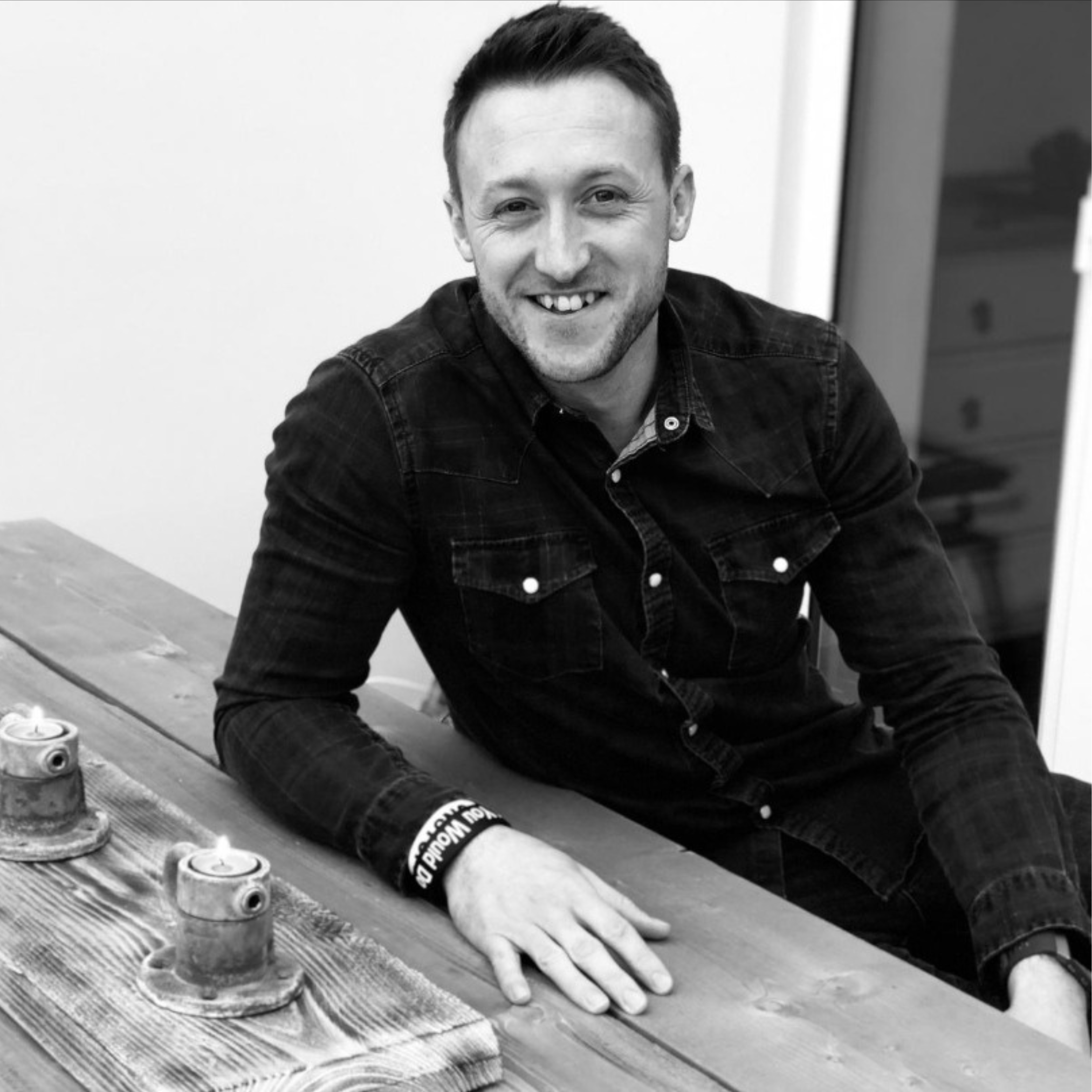
Full transparency: I still drink on occasion.
How does The Sinclair Method actually work?
When you drink, alcohol triggers the release of endorphins, your body's own feel-good chemicals.
They land on opioid receptors in the brain… And that provides a reward.
… And every drink that pays out a reward, teaches your brain the same lesson... Drink equals a reward… This is worth repeating.
Naltrexone interrupts that reward pathway; it sits on those opioid receptors, blocking them, so the endorphins have almost nowhere to land, which is how the reward cycle is interrupted.
You still feel the alcohol. You can still get drunk (being drunk is not the reward - many people confuse this)... What goes is the reward.
"My drinking was like having a second job."Matt Brindley
How long would you keep turning up at work if you stopped getting paid?
A couple of days? Is this real... This can't be right...
Then you'd stop going. The pay was the reason you went.
Your brain works the same way. With the reward blocked, every drink is a shift with no pay. Over time, it questions the relationship & the benefit of the drinking behaviour.
Behavioural scientists call this extinction: a learned behaviour fades when it stops being rewarded. That's why it takes time.
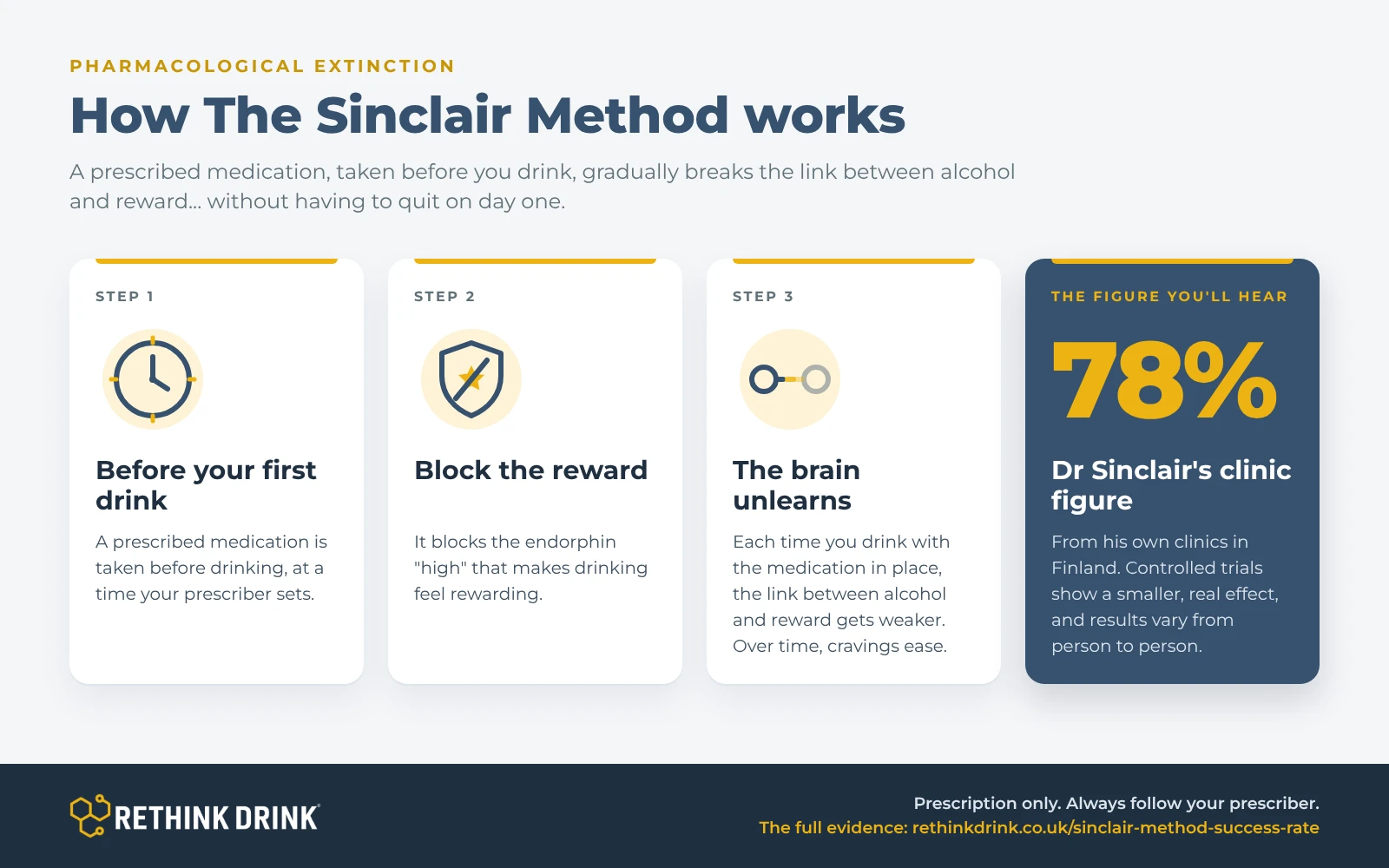
Let's be straight about the 78%
You'll see the 78% figure everywhere, including on our own infographic.
- It comes from a Finnish study Dr Sinclair reported in 2001, from his own clinics.
- Of the 147 patients who stayed in treatment long enough to be assessed, 115 (78%) were judged successful.
- There was no placebo group, and people who dropped out early weren't counted.
That doesn't make it wrong. It makes it a clinic figure. Not a controlled trial. Controlled trials, where some people get a dummy pill, show a smaller effect. A real one. And results vary from person to person.
What the research really shows, including what it can't tell youHow do you take it? Every day?
No. Not on The Sinclair Method.
It's taken only before you drink. Your prescriber decides how and when you take it.
And the method is built around the medicine being in place when you drink. Drinking without it lets the old reward back in… It will reinforce the old relationship/habit/behaviour.
The same medicine is used in two completely different ways in the UK:
Usual NHS use
- Drinking
- You usually stop first
- How it's taken
- Daily
- The goal
- Staying stopped
- In UK guidance
- A first-choice medicine after stopping
The Sinclair Method
- Drinking
- You start from wherever your drinking is today
- How it's taken
- Only before drinking, as your prescriber decides
- The goal
- Weakening the desire over time, so you drink less, or stop if you choose to
- In UK guidance
- Outside UK guidelines and outside naltrexone's UK licence
Same medicine. Different method. Different goal.
Something I hear a lot online is "The Sinclair Method didn't work for me". Whenever I've dug into it, it was almost always taken with no plan and no support.
Daily, after stopping, is the licensed NHS method. The Sinclair Method is taken only before drinking, as the prescriber sets. Mixing the two up on your own makes it hard to know what's happening.
I tried naltrexone and it didn't work. Why?Before you start
A doctor needs to check whether your body depends on alcohol, your liver, and any medicines you take. Naltrexone isn't suitable with opioid painkillers like codeine or tramadol, or with certain liver problems… That is down to your prescribing doctor to discuss with you.
Has anyone here actually done it?
Matt BrindleyCo-founder, Rethink Drink. Started The Sinclair Method in October 2022.
Yes. Our co-founder, Matt, started in October 2022.
In his own words:
Before that, I'd spent close to two decades trying to get a handle on my drinking: rules, counselling, CBT, SMART Recovery, Alcoholics Anonymous (AA), an anti-craving medication.
I'd done six months without drinking once. But alcohol always felt like it was waiting for me.
I was drinking four to seven nights a week. Eight to ten cans a night. Still going to the gym. Still going to work. From the outside, I looked fine.
But inside, I was crumbling, struggling to hold it together, my mental health declining, I was becoming a shell of myself… My confidence was disappearing, and I didn't want to do anything, I was losing interest in everything and life felt flat.
I took my tablet and waited.
… To be honest, I wanted this to work so badly, I'm pretty sure a paracetamol would have slowed down my drinking!
It felt unique… A bit like drinking non-alcoholic beer, but still getting drunk.
I got to the fifth drink. Poured the sixth. Drank half. And stopped. I had never done that before.
My wife was out at a full-day Christmas event. Alone time used to mean all-day drinking.
The thoughts still came. Two or three conversations with myself... And then it was done.
I could say no. Calm. Neutral. Mine.
A few months later, after a day alone in the workshop with no lunch, I got in the van... Which used to mean a stop for vodka on the way home.
I genuinely wondered if it had stopped working.
It hadn't. The Sinclair Method had quietened the addiction. But it left me with my habits and triggers.
… And no one had walked me through this side of things (this is the point where Rethink Drink was born).
Because once the addiction is quieter, the habits and triggers (the behaviours that keep our drinking routine alive) need to be worked on.
For full transparency - I still choose to drink; cocktails by the pool, beers at a bbq or with a curry, weddings, birthdays, Christmas - these are the times I drink now.
This is a small insight into Matt's experience, not a promise of yours. If there's one thing he's learnt in the thousands of coaching conversations he's had, it's that everyone's journey is different.
Before finding The Sinclair Method, Matt tried AA too. Plenty of people find what they need there, and we'd never knock it.
The Sinclair Method and AA: what's the difference?Can I get it from my GP or the NHS?
Naltrexone is available on the NHS. But usually as a daily medicine, from a specialist alcohol service (usually secondary care), once you've stopped drinking.
Using it The Sinclair Method way is possible on the NHS, but uncommon. It's outside UK guidelines and the licence, so most NHS doctors won't.
Please don't let that end your search.
Your GP (General Practitioner) is a generalist by design. Alcohol treatment is a specialist field, and The Sinclair Method is a specialist subject within it. That's how the NHS is set up, not your GP failing you.
It's still worth going. Your GP can check your health and refer you to free local support.
How much does The Sinclair Method cost?
There's no single price, because you're usually paying for a few separate things:
Rethink Drink's programmes, and prices, can be found here:
See our programmes and pricesWhoever you go to, ask:
- Is the prescriber registered with the General Medical Council, and the pharmacy with the General Pharmaceutical Council?
- Are there additional fees? (repeat prescriptions, annual consultations or blood tests)
- What checks happen before I start?
- What support is included, and what happens if it isn't working for me?
How long does it take?
Months, not days.
What members notice first is their awareness around their drinking increasing - they hear the voice that is saying to drink less, or not to drink becomes clearer. Then signs like these:
The "it's not working" moment. A common point when people think it's not working is when they drink what they used to, or their drinking plateaus (after seeing a reduction)... In our coaching, this happens for most people, as often the habit hasn't been worked on (taking a tablet cannot change our habits).
I was quicker than many people (known as a fast-responder). So please don't measure yourself against my story, or anyone else's online… Your journey will be your journey.
Does it work, and why is it controversial?
It can help many people. Not everyone.
People push back for honest reasons
- Drinking while on treatment can sound like enabling, when the point is that every drink with the reward blocked weakens the habit.
- It's off-label in the UK, and doctors who prescribe outside a licence take personal responsibility for it, so many won't.
- And the 78% gets quoted as a success rate it was never designed to be.
Some experts believe stopping completely is the safer goal. For some people, it's the right one.
Where did The Sinclair Method come from?
Dr John David Sinclair was an American scientist. After his PhD, he moved to Helsinki, to the research laboratories of Alko, the Finnish state alcohol company.
Who owns The Sinclair Method?
No one. The Sinclair Method is a medical approach, named after Dr John David Sinclair, the researcher whose work it's based on. It's not a brand or a franchise, and it's not a registered trade mark in the UK.
Think of it like cognitive behavioural therapy (CBT): an established method that many different practitioners offer.
So when an organisation calls itself "official", that's a description it has chosen, not a status anyone has granted, or can grant.
Every organisation working with The Sinclair Method, us included, builds on Dr Sinclair's work.
Many people in the UK, including myself, heard about it through Claudia Christian. I found her by accident, through YouTube autoplay... And for the first time, someone was talking to me logically; about the brain, not morality.
Why is the method more than the pill?
On the NHS, naltrexone isn't meant to be given on its own. NICE recommends it alongside psychological support, as part of a treatment plan.
"When an opioid antagonist is taken in combination with psychosocial support, many of my patients find they are better able to stop after one or two drinks, to build more alcohol-free days, and to gradually extinguish long-held cravings. Programmes such as Rethink Drink provide the coaching, guidance, accountability, and structured support that make this possible."
The Sinclair Method asks something extra: you keep drinking while it works. Your drinking comes down over time, and someone needs eyes and ears on how that's going, week by week. A ten-minute GP appointment every few weeks can't support that.
Over time, the medicine can quieten the desire... But:
That's the work. And that's where you get your choices back.
The pattern is almost always the same: the tablet does its job, and then the real work starts. That's where the coaching earns its keep... It's so overlooked.
Common questions
Do you still get drunk on The Sinclair Method?
Yes. The usual rules about driving and safety still apply. What fades is the reward that keeps you wanting more.
Do I have to stop drinking before I start?
No. But if your body depends on alcohol, a doctor needs to look at that first. Do I need a detox first?
Will it make me feel ill?
Some people get side effects in the first days or weeks, most commonly nausea, headaches or dizziness. If anything worries you, talk to your prescriber. More on side effects.
Does naltrexone block all pleasure?
No. It works on the opioid part of the brain's reward system, which is how it dampens the reward from alcohol. Some people can feel flat, but this is also a side-effect of alcohol reduction, so tell your prescriber if you do. Does naltrexone block all pleasure?
Can I take it with other medicines?
Some, yes. Not with opioid painkillers or opioid treatment. Tell your prescriber everything you take. Does naltrexone interact with other medicines?
Is there an official Sinclair Method provider?
No. The Sinclair Method is named after Dr John David Sinclair, the researcher whose work it's based on. It's not a brand, a franchise or a registered trade mark in the UK, and no one can grant "official" status. Like CBT, it's an established method that many different practitioners offer.
Is it for life?
Not necessarily… That is part of the choice. Sinclair's advice was to keep using it whenever you drink. Some stop drinking altogether. Is the end goal abstinence or control?
Rethink Drink: The Sinclair Method, with a coach beside you
Rethink Drink is a UK coaching service built around The Sinclair Method. Our programmes include a consultation with an independent prescriber, who decides whether treatment is suitable. Clinical oversight is provided by consultant psychiatrist Professor Jonathan Chick. Any prescription is dispensed by an independent partner pharmacy. Our coaches work with you, week by week, on everything around it.
Book a free discovery call See programmes and pricesPlease look after yourself. This page is here to help you understand your options. It isn't medical advice, and it can't replace a conversation with a doctor who can ask qualifying questions.
Before you change how much you drink or start any medication, speak to your GP or a prescriber.
And whatever happens, you can talk to someone today. Drinkline, the national alcohol helpline, is free and confidential: 0300 123 1110. Any questions for us? Contact us here.
Sources (13)
- Sinclair JD, Senter RJ. Increased preference for ethanol in rats following alcohol deprivation. Psychonomic Science, 1967. doi.org/10.3758/BF03330642
- Sinclair JD. Method for treating alcohol-drinking response. US Patent 4,882,335, filed 1988, granted 1989. patents.google.com/patent/US4882335
- Sinclair JD. Evidence about the use of naltrexone and for different ways of using it in the treatment of alcoholism. Alcohol and Alcoholism, 2001; 36(1): 2 to 10. doi.org/10.1093/alcalc/36.1.2
- Heinälä P and colleagues. Targeted use of naltrexone without prior detoxification in the treatment of alcohol dependence. Journal of Clinical Psychopharmacology, 2001. doi.org/10.1097/00004714-200106000-00006
- Rösner S and colleagues. Opioid antagonists for alcohol dependence. Cochrane Database of Systematic Reviews, 2010. cochrane.org/CD001867
- Harvard Health Publishing. Can you retrain your brain to stop excessive drinking? February 2026. health.harvard.edu
- MHRA Products. Adepend 50 mg film-coated tablets (naltrexone hydrochloride): Summary of Product Characteristics, listed with the other UK naltrexone products. products.mhra.gov.uk
- NICE. Alcohol-use disorders: diagnosis, assessment and management of harmful drinking (high-risk drinking) and alcohol dependence (CG115). nice.org.uk/guidance/cg115
- NICE. Nalmefene for reducing alcohol consumption in people with alcohol dependence (TA325). nice.org.uk/guidance/ta325
- Department of Health and Social Care. UK clinical guidelines for alcohol treatment, chapter 10: pharmacological interventions.
- General Medical Council. Good practice in prescribing and managing medicines and devices: prescribing unlicensed medicines.
- One Little Pill (documentary, 2014), directed by Adam Schomer, narrated by Claudia Christian.
- NHS. Alcohol use disorder. nhs.uk/conditions/alcohol-misuse
How Can We Help?
Everyone starts in a different place.
What matters is taking the next step that fits you.

Want to Know More?
Discover The Sinclair Method in our free mini-course. Start today.

Need to talk it through?
Book a no-obligation discovery call.
Get your questions answered.

Ready For Change?
Start your transformation.
Control is the goal.
