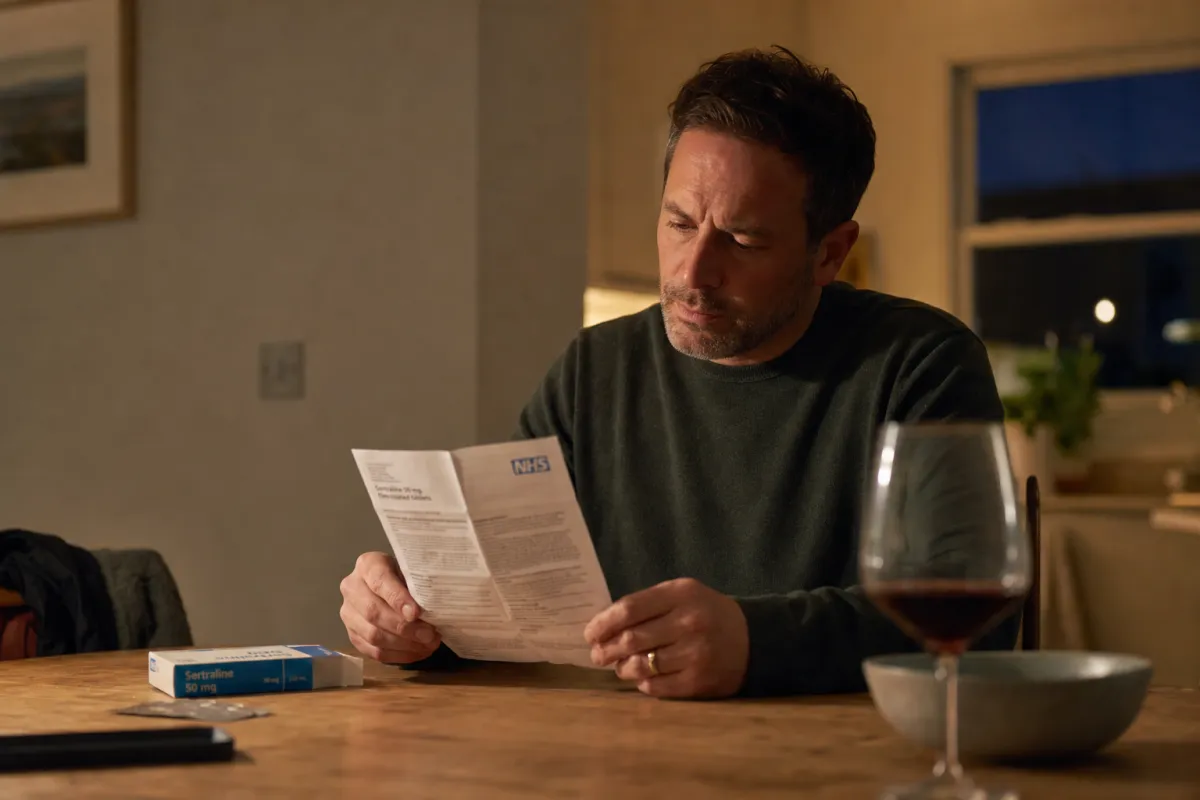
Can You Drink on Antidepressants? Why Alcohol Can Quietly Undercut the Help You're Trying to Get
If you are wondering whether you can drink on antidepressants, the most useful short answer is this: alcohol can make side effects worse, blur whether the medication is helping, and keep the same anxiety, sleep, and mood cycle going.
...That matters even when your drinking still looks fairly normal from the outside.
For many people, It's not really a question about one glass of wine or one night out. It's a question about why they are trying to feel better, taking medication seriously, and still ending up in the same loop by evening.
This is where the frustration starts. You do the responsible thing. You ask for help. You take the tablets. But the drinking pattern carries on just enough to muddy the waters. Now you do not know what is the medicine, what is the alcohol, and what is simply exhaustion.
Why this question matters more than people appreciate...
The NHS advice is fairly plain. Alcohol can worsen symptoms and increase side effects with antidepressants. NHS guidance states that alcohol can make people feel sleepy when taking citalopram, while the NHS guidance for sertraline advises avoiding alcohol because it can stop the medicine working properly.
That does not mean every person will react in exactly the same way.
It does mean this is not a trivial combination.
The bigger issue is often not a dramatic interaction. It is the quieter problem of interference.
Alcohol can make you more tired, foggy, or flat.
It can worsen sleep, even if it seems to relax you at first.
It can amplify anxiety the next day.
It can make it harder to tell whether the medication is helping at all.
So when people ask, “Can I drink on antidepressants?”, the real question should be:
“Am I making my own recovery harder without realising it?”
What alcohol does to the process of getting better
One of the hardest parts of changing your relationship with alcohol is that the damage is not always loud. If you were being sick every morning or missing work, the answer might feel obvious. But for a lot of capable adults, it looks more subtle than that.
You still function. You still meet deadlines. You still look fine. Yet your evenings are negotiated around alcohol, your sleep is patchy, your mood is unpredictable, and the relief you are chasing does not really last.
When antidepressants enter that picture, alcohol can interfere in three important ways.
1. It muddies the signal
Antidepressants often take time. Dose changes take time too. If alcohol is still in the mix several nights a week, it becomes much harder to judge what is actually working. You can end up concluding that the medication has failed, when the reality is that your nervous system is getting mixed messages.
2. It keeps the same anxiety and sleep loop alive
A drink may feel like it takes the edge off in the moment. But if you regularly wake at 3am, feel wired the next day, or notice that your mood dips after drinking, alcohol may be reinforcing exactly the symptoms you are trying to reduce. That is one reason articles on alcohol and sleep keep resonating with people who thought they were using it as a solution.
3. It can preserve the old reward pattern
If alcohol has become your main switch for relief, reward, or decompression, medication alone may not resolve that learned pattern. This is where people can start to feel stuck. They are not simply battling stress. They are repeating a deeply reinforced behaviour that still fires at the same time, in the same places, for the same reasons.
Why high-functioning drinkers get trapped
The people most likely to miss this are often the ones least likely to match the stereotype. They are working, parenting, socialising, and looking broadly competent. From the outside, nothing seems urgent enough to justify real change.
But internally, it can feel exhausting. You are trying to improve your mental health while still depending on the very thing that may be unsettling it. That creates a miserable kind of half-progress.
You may not need a dramatic label to take that seriously. You may simply need to admit that alcohol is taking up more space than it should, and that the “small amount” you keep defending is not actually neutral in your life.
What to do if this sounds familiar
This is not a reason to stop antidepressants suddenly or change medication on your own - You should always consult your doctor/prescriber regarding ANY changes to medication... But it is an opportunity to get clearer.
Read your own medicine guidance again. Different medicines carry different cautions, so use your NHS leaflet, pharmacist, or prescriber rather than guessing.
Look at the pattern, not just the quantity. Ask what happens to your sleep, mood, morning anxiety, and cravings after drinking, even when the amount seems reasonable.
Run an honest experiment. A short period of drinking less can show you far more than another round of internal debate.
Notice whether alcohol is still your main relief switch. If it is, the issue may be behavioural and neurological as much as emotional.
Get support before it looks catastrophic. You do not have to wait until life is visibly falling apart to take this seriously.
If you keep finding yourself back in the same loop, it may help to read what the Sinclair Method actually is and whether Rethink Drink might be the right fit. For some people, the missing piece is not more guilt or more rules. It is a better mechanism.
What Rethink Drink would say here...
At Rethink Drink, the goal is not to sound anti-medication or anti-treatment. Quite the opposite. If something is meant to help your mood, your anxiety, or your sense of stability, the job is to give it the best possible chance to work.
That sometimes means looking honestly at the role alcohol is still playing. Not because you have failed. Not because you need a more dramatic identity. Simply because trying to feel better while alcohol quietly keeps the same loop alive is a frustrating way to live.
If reading this page has made you pause & think, you can book a discovery call to find out more, read how others have approached change on the reviews page, or use the alcohol units calculator if you want a clearer baseline first.
FAQ
Can you drink alcohol while taking antidepressants?
Sometimes people do, but that does not automatically mean it is a good idea. NHS guidance warns that alcohol can worsen symptoms, increase sleepiness or dizziness, and in some cases interfere with how the medication works. The safest advice is to check the guidance for your specific medicine and speak to a pharmacist or prescriber if you are unsure.
Why does alcohol make antidepressant treatment harder?
Because it can blur the picture. Alcohol can affect sleep, mood, anxiety, energy, and side effects, so it becomes harder to tell whether the medication is helping or whether you are still reinforcing the same cycle every evening.
Should I stop my antidepressants if I want to cut down on drinking?
No. Do not stop or change antidepressants without medical advice. If you are worried about the combination, speak to your GP, prescriber, or pharmacist and get specific guidance for your medication.
Is this only a problem if I drink heavily?
Not always. For some people, the real issue is not obvious “heavy drinking” but regular drinking that keeps worsening sleep, next-day anxiety, or the feeling that treatment is not really landing.
What if I am taking medication and still keep coming back to alcohol?
That usually means the problem is bigger than motivation alone. If the same promises keep breaking down, it may be worth exploring a more structured approach to the alcohol pattern itself, not just trying harder around the edges.
If you are in immediate distress, worried about your safety, or feeling much worse after mixing alcohol with medication, seek urgent clinical help through NHS 111, your GP, or emergency services as appropriate.