Grey Area Drinking: Can You Have an Alcohol Problem If Life Still Looks Fine?
If work is getting done, the bills are paid, and no one looking in from the outside would say anything is badly wrong, it can be surprisingly hard to admit if alcohol is an issue.
Grey area drinking is not a medical diagnosis. It is a useful phrase for people whose drinking still looks functional from the outside but is creating growing internal cost, such as loss of control, mental load, poor sleep, anxiety, broken promises to self, or a sense that alcohol is taking up too much space.
If you have found yourself wondering whether your drinking is becoming a problem, then immediately talking yourself out of the question, you are not alone.
Maybe your life still looks respectable.
Maybe no one around you would use dramatic words.
Maybe you are still functioning well enough to keep telling yourself that this cannot really count.
And yet alcohol is taking up more room than you want it to.
You think about it more than you used to.
You set limits, then move them.
You promise yourself tonight will be different, then find yourself back in the same negotiation a few days later.
That is exactly where the phrase grey area drinking becomes useful.
What is grey area drinking?
Grey area drinking is not a clinical term.
You will not find it used by the NHS as a diagnosis.
But it describes a very real experience.
It is the space where drinking still looks fairly normal from the outside, while privately starting to feel too important, too hard to control, or too costly to ignore.
For some people that shows up as wine most nights. For others it is weekend bingeing, repeated overdoing it after work, or needing alcohol to switch off, socialise, sleep, or reward yourself.
What links these experiences is not drama.
It is the creeping sense that alcohol has more influence than you want it to have.
Grey area drinking often looks like this
Drinking more than you planned once you start
Spending too much energy making rules with yourself
Using alcohol to mark the end of the day or change your mood
Feeling relief when you drink, then regret or anxiety the next day
Noticing sleep, motivation, confidence or self-trust getting worse
Looking fine publicly while feeling less free privately
The problem is usually control, not collapse
A lot of people stay stuck because they are using the wrong test.
They ask whether they look bad enough.
Whether they are drinking more than somebody else.
Whether their life is falling apart enough to justify concern.
Those questions usually keep the issue safely out of reach.
Better questions are these:
Can you reliably do what you said you were going to do around alcohol?
Can you stop where you planned to stop?
Can you take it or leave it without a draining internal argument?
Can you trust your own decisions around it?
If the answer is increasingly no, that matters...
It matters even if your calendar is full, your career is intact and your friends would still describe you as high-functioning.
Why this can feel so confusing
Most people have absorbed a very narrow picture of what a drinking problem is supposed to look like.
It is dramatic.
It is obvious.
It is someone else.
So when your own life still looks broadly normal, it can feel overblown to take the issue seriously.
That false binary keeps a lot of capable people stuck for years.
Either I am fine.
Or I fit a traditional stereotype.
If I do not fit the stereotype, I must be fine.
But that is not how alcohol problems work.
Clinical guidance talks about harmful drinking, dependence and alcohol use disorder on a spectrum. It focuses on pattern, symptoms and loss of control, not on whether someone still looks successful from the outside.
That matters because a lot of people only seek help far later than they needed to, simply because they thought they had to earn concern first.
How alcohol quietly takes more space
Grey area drinking usually grows by stealth.
It becomes the shortcut.
The way to switch off.
The reward after a long day.
The social relaxer.
The thing that makes the evening feel like yours again.
At first, that can feel harmless.
Then the pattern deepens.
You stop deciding from a neutral place.
Your brain starts to associate alcohol with relief, reward and the end of effort.
That is why intelligence alone does not solve it.
This is not random and it is not weakness.
It is learning.
Alcohol triggers reward and relief pathways in the brain. Repeated often enough, the brain starts to expect that outcome. That is one reason moderation can feel straightforward in theory but unreliable in real life.
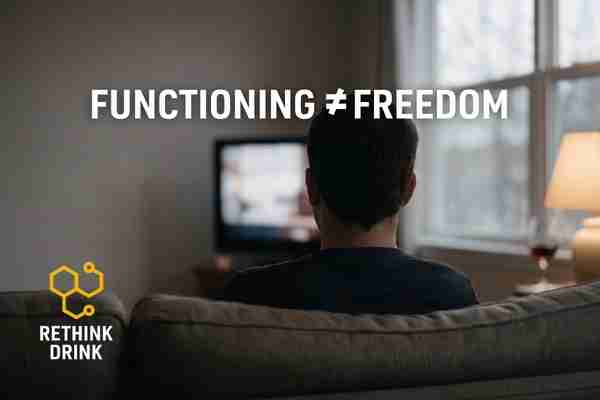
Functioning does not mean it is not costing you
You can still be showing up at work, keeping promises to other people and holding life together while privately losing sleep, headspace, confidence and trust in your own off switch.
A practical UK reality check
In the UK, the low-risk drinking guideline is not to regularly drink more than 14 units a week, and if you do drink that much, to spread it over 3 or more days.
That does not mean anyone above 14 units automatically has a formal alcohol problem.
But it does give you a more objective marker than gut feel alone.
If you are not sure where you stand, Rethink Drink has an alcohol units calculator that can help you sense-check what is really happening over a week.
For many people, the surprise is not just the total.
It is the pattern.
How often alcohol appears. How much thinking goes into it. How difficult it feels to leave it alone.
What to do if this sounds uncomfortably familiar
You do not need to panic.
You do not need to pick a label on the spot.
And you do not need to wait until things get worse.
You do need honesty.
A useful next step is to ask:
Am I drinking more often or more heavily than I want to?
Do I keep making rules and breaking them?
Is alcohol affecting my sleep, anxiety, energy, health or relationships?
Do I feel less free around alcohol than I used to?
Have I been waiting for certainty when concern alone is already enough to pay attention?
If the answer is yes to several of those, it may be time to look at a more structured approach.
Where The Sinclair Method fits
For some people, the issue is not a lack of desire to change.
It is that willpower keeps getting outmatched by reinforcement, routine and real-life triggers.
That is where The Sinclair Method can become relevant.
It is an evidence-based approach that uses prescription-only medication, taken under medical supervision, to reduce the brain’s reward response to alcohol over time. The medication side addresses chemistry. The support side addresses habits, stress, routines and the moments where people usually get pulled back into the same loop.
That does not make it a fit for everyone.
And it is not a quick fix.
But for people who do not relate to abstinence-first models and keep finding themselves stuck in the same moderation battle, it can be a more intelligent place to look.
If you want to explore that properly, start with whether Rethink Drink is right for you, read real reviews, or book a Discovery Call if you want to talk it through calmly.
You do not have to wait for a dramatic ending
One of the most damaging myths around alcohol is that concern only counts once life has visibly fallen apart.
That is simply not true.
If alcohol is taking more control, more headspace and more self-trust than you want to give it, that is enough to pay attention.
A calmer, more honest next step is often where real change begins.
See whether this approach fits
Book a confidential Discovery Call
Frequently asked questions
Is grey area drinking a diagnosis?
No. Grey area drinking is not a formal medical diagnosis. It is a useful phrase for a pattern many people recognise when life still looks functional but alcohol is taking too much control, headspace or freedom.
Can you have an alcohol problem if you still work and function normally?
Yes. Outward functioning does not rule out harmful drinking or dependence. The more useful question is whether alcohol is becoming harder to control or is affecting your sleep, anxiety, health, relationships or self-trust.
Does grey area drinking mean I have to quit forever?
Not necessarily. The goal is clarity and control first. Different people end up wanting different outcomes, including moderation, very low drinking or abstinence. What matters is finding an approach that is safe, realistic and properly supported.
Why does willpower stop working around alcohol?
For many people, alcohol becomes linked with relief, reward and routine. Once that learning is reinforced often enough, intention alone can start to lose against stress, cues and habit. That is why structure and the right support matter.
Is The Sinclair Method right for everyone?
No. The Sinclair Method is not suitable for everyone and any medication involved is prescription-only and must be assessed by a qualified healthcare professional. It can be a strong option for some people, but it should be explored properly rather than assumed.
Medical note: This article is for educational purposes only and is not a substitute for personalised medical advice. If you may be physically dependent on alcohol, or if medication is being considered, seek advice from a qualified healthcare professional before making changes.