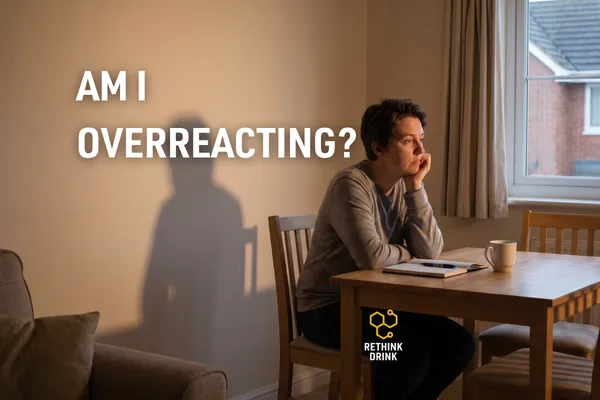
Am I Overreacting to My Partner’s Drinking? How to Spot the Quiet Signs
It can be strangely lonely to worry about someone else's drinking.
You are not the one opening the bottle, but you are still living with the pattern. You notice the mood shift. You brace for the repeated conversation. You wonder whether you are overreacting because life still looks broadly normal from the outside.
Worrying about someone else's drinking usually means the issue is not only how much they drink. It is how alcohol is starting to shape trust, mood, routines and your sense of ease at home, even if nobody else would call it a crisis yet.
That middle ground is exactly where many families get stuck. It does not look dramatic enough to justify a big intervention, but it does not feel fine either.
If that is where you are, the goal is not to become a detective, a parent, or a permanent monitor. The goal is to respond early, clearly and usefully before the pattern hardens.
Why this question matters more than people admit
Recent UK reporting and support data keep circling the same truth from different angles. Shame delays help. Families carry more than they say out loud. And a lot of people wait for stronger proof before they trust their own concern.
That delay makes sense emotionally, but it often makes things harder practically. By the time everyone agrees there is a problem, the relationship may already be carrying months or years of tension, negotiation and lost trust.
This is one reason the old stereotype is so unhelpful. If you are waiting for chaos, public fallout or obvious dependency before you let yourself take the issue seriously, you can end up dismissing the quieter signs that matter in real life.
Signs the issue is bigger than the number of drinks
You do not need to count every unit to recognise that alcohol is affecting the relationship. Often the pattern shows up first in the atmosphere around drinking.
You feel yourself scanning the evening around whether they will drink, how much, and what mood will follow.
Plans keep changing once alcohol enters the picture.
Conversations about drinking go nowhere, or end in minimising, defensiveness or jokes.
Promises to cut down appear regularly, but the overall pattern does not really move.
You are carrying the emotional admin of the issue on your own.
You keep telling yourself it is not serious enough yet, while feeling less and less settled.
Those signs point to loss of ease, predictability and trust. That is real impact, even when the person drinking is still functioning well at work or socially.
What helps more than watching and waiting
If you are worried, the most helpful next step is usually not a dramatic showdown. It is a calmer shift from private monitoring to clearer boundaries, better timing and better support.
Pick a sober, ordinary moment. Do not start the conversation in the middle of drinking, after an argument, or when you are both emotionally flooded.
Talk about patterns and impact, not labels. "I feel on edge every evening because I do not know how the night is going to go" lands better than arguing about whether they qualify as a particular type of drinker.
Be specific. Name what you have noticed, what it is costing, and why you are raising it now.
Avoid the courtroom approach. A pile of evidence rarely creates openness. It usually creates a defence brief.
Decide what support you need as well. This matters. You may need guidance even if they are not ready yet.
In other words, try to move from "How do I prove this is bad enough?" to "What would a more honest and more sustainable response look like now?"
What not to do
People often swing between saying nothing and saying everything. Neither extreme helps much.
Do not make your whole life revolve around reading the room.
Do not take repeated reassurance at face value if nothing practical is changing.
Do not assume that being high-functioning means the issue is minor.
Do not wait for a catastrophic moment just to feel entitled to seek support.
Do not carry the whole burden alone because you worry it is somehow disloyal to speak honestly.
When repeated promises to cut down are not changing much
This is often the point where families become exhausted. The intention may be real, but the pattern keeps returning. If that sounds familiar, it can help to look beyond willpower-only solutions.
For some people, the missing piece is understanding that drinking behaviour is not just a motivation problem. It can also be a learned cue-and-reward loop that needs a different kind of interruption. If you want to understand that approach, this guide to what the Sinclair Method is explains why some people do better with an evidence-based method that targets the drinking pattern itself.
If you are trying to figure out whether this kind of support could fit your situation, Rethink Drink also has a dedicated Support a Loved One page for partners and families. That route is often more useful than trying to manage the whole situation privately for another six months.
You need support too
One of the most damaging myths in this area is that only the person drinking is allowed to need help. In reality, families often absorb the uncertainty, second-guessing and stress long before anyone uses clinical language.
If you are carrying that strain, it is reasonable to get informed now. You do not need to wait until everything looks disastrous from the outside. You can read more about fit on Is Rethink Drink Right for Me?, look at client reviews, or book a straightforward discovery call if you want to talk through what is happening without turning it into a dramatic family summit.
FAQ
How do I know if I am overreacting to someone else's drinking?
If alcohol is changing the mood at home, creating repeated arguments, or making you feel watchful and unsettled, that is worth taking seriously. You do not need external proof that it is "bad enough" before responding honestly.
Should I confront my partner about their drinking?
A calm conversation in a sober moment is usually better than a confrontation. Aim for honesty, specifics and impact rather than accusation. The point is to open a useful conversation, not to win a case.
What if they say they are fine because they still function well?
High functioning does not automatically mean low impact. Many people keep work and social life going while alcohol is still damaging trust, consistency and self-control behind the scenes.
When should I seek urgent help?
If there is immediate risk, severe withdrawal, threats of self-harm, violence, or medical danger, use urgent services rather than a blog article. In the UK that may mean NHS 111, emergency services, or immediate local clinical support.
You are allowed to trust what you can already see. If someone else's drinking is changing life around you, that is reason enough to stop watching and start getting proper support.