A Postcode Lottery for Alcohol Medicines
By Matt Brindley.
In short
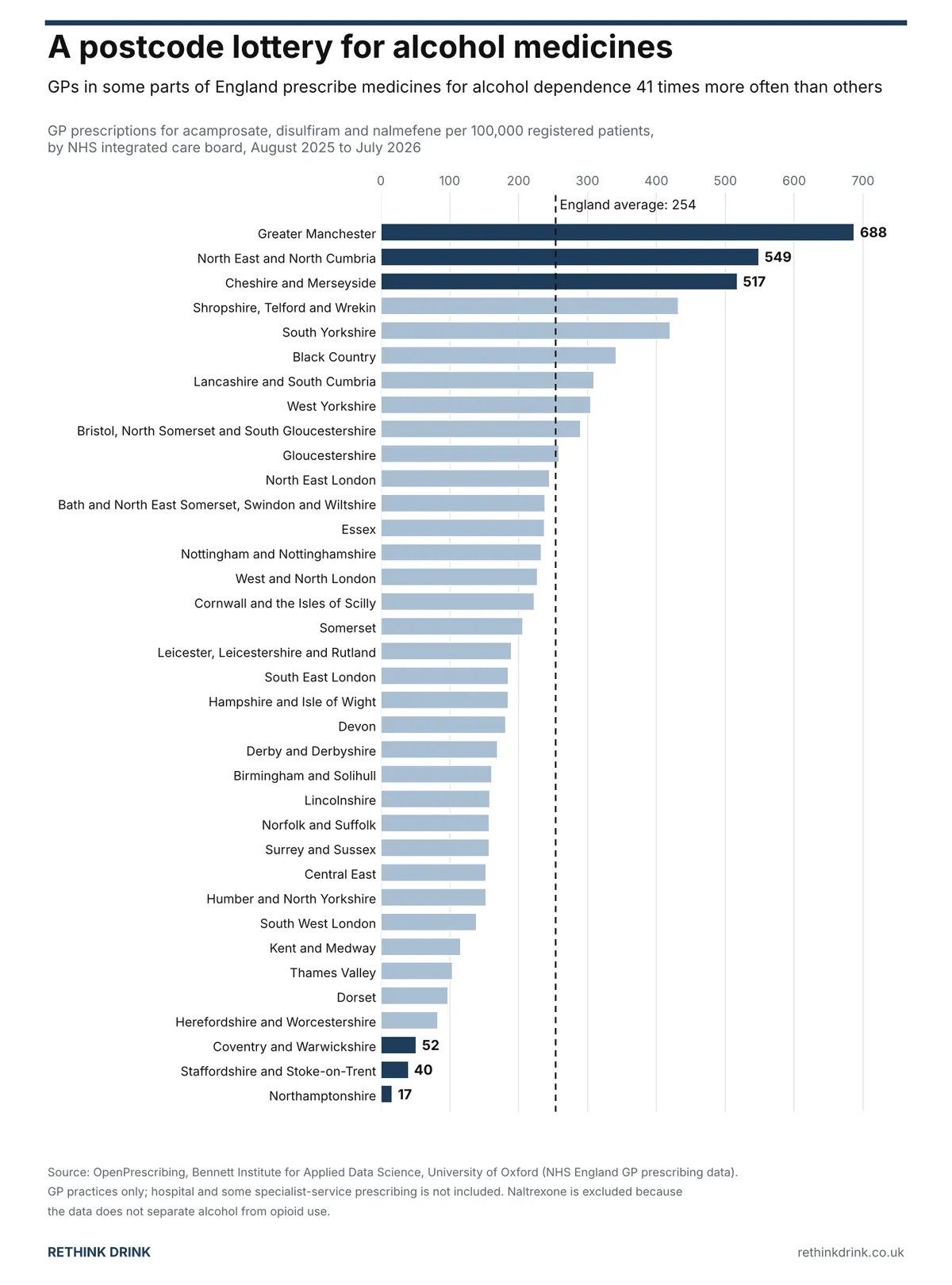
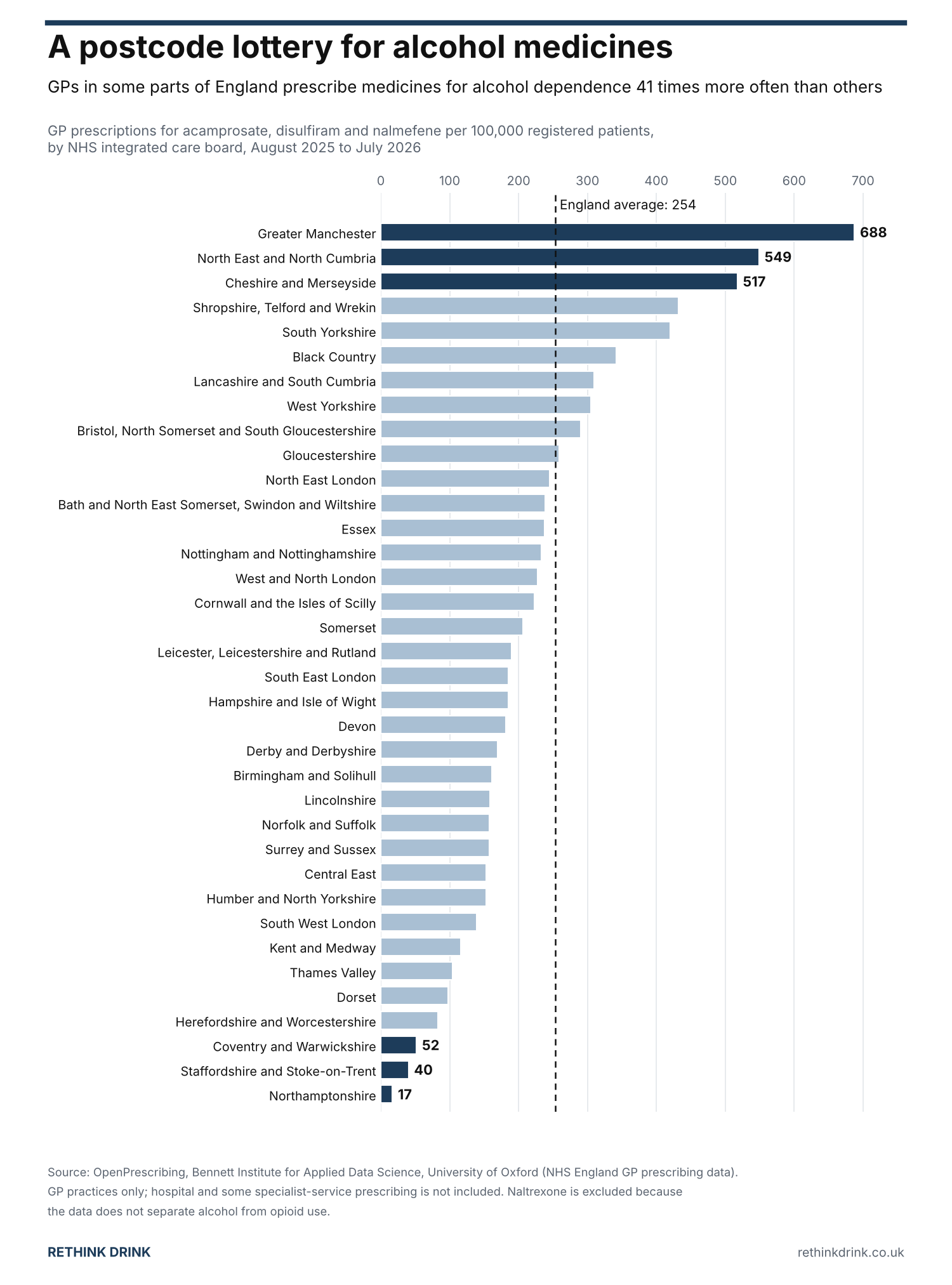
41 times. GPs in Greater Manchester prescribed medicines for alcohol dependence 41 times more often per patient than GPs in Northamptonshire, in the 12 months to July 2026.
The average. Across England it was about 254 prescriptions per 100,000 patients. 26 of the 36 areas were below it, and 7 were under half of it.
The lowest areas: Northamptonshire (17), Staffordshire and Stoke-on-Trent (40) and Coventry and Warwickshire (52).
What it doesn't tell you. It's GP prescribing only. In some areas, specialist alcohol services may prescribe directly instead.
If you live in a low area, you can still ask. Your GP, your local alcohol service and private prescribers are all routes.
What did we look at?
Three medicines are used in England specifically for alcohol dependence: acamprosate, disulfiram and nalmefene. We counted every GP prescription for them over 12 months, in each of England's 36 NHS integrated care boards, and divided by the number of patients registered with GPs there.
The figures come from OpenPrescribing, run by the Bennett Institute for Applied Data Science at the University of Oxford, which publishes NHS England's GP prescribing data.
Why does it vary so much?
The data can't tell us that on its own. Some likely reasons:
Who prescribes. In some areas GPs continue prescriptions started by a specialist service. In others, the specialist service prescribes directly, and that doesn't show up in GP data.
Local rules. Each area decides which medicines GPs can prescribe and who has to start them.
Need. Rates of alcohol harm differ across the country.
So a low number doesn't prove that people in that area can't get help. But it does mean the route to these medicines looks very different depending on where you live.
What about naltrexone?
Naltrexone is also used for alcohol, but the same medicine is prescribed for opioid problems, and the data doesn't separate the two. So it isn't in the chart. Across England, GP practices issued about 20,000 naltrexone prescriptions in the year, for both uses combined, against about 171,000 for acamprosate.
Our page on naltrexone and The Sinclair Method explains why it's so rarely prescribed for alcohol.
I live in a low-prescribing area. What can I do?
Ask your GP anyway. Low numbers don't mean a no.
Contact your local alcohol service. In many areas you can refer yourself: find one in England.
Know your options. Our guide to alcohol treatment in the UK compares every route, NHS and private.
Check first: If your body depends on alcohol, speak to your GP or local alcohol service before you stop or cut down.
The full table
GP prescriptions per 100,000 registered patients, August 2025 to July 2026, ranked. Nalmefene is shown as a count because the numbers are so small.
Rank | Area (integrated care board) | All three medicines | Acamprosate | Disulfiram | Nalmefene (prescriptions) |
|---|---|---|---|---|---|
1 | Greater Manchester | 688 | 622 | 63.8 | 64 |
2 | North East and North Cumbria | 549 | 520 | 28.5 | 6 |
3 | Cheshire and Merseyside | 517 | 491 | 24.4 | 64 |
4 | Shropshire, Telford and Wrekin | 432 | 400 | 30.8 | 3 |
5 | South Yorkshire | 420 | 343 | 77.5 | 0 |
6 | Black Country | 342 | 316 | 22.8 | 35 |
7 | Lancashire and South Cumbria | 310 | 279 | 30.0 | 15 |
8 | West Yorkshire | 304 | 252 | 52.1 | 0 |
9 | Bristol, North Somerset and South Gloucestershire | 290 | 276 | 12.1 | 24 |
10 | Gloucestershire | 259 | 220 | 38.9 | 3 |
11 | North East London | 245 | 241 | 3.6 | 2 |
12 | Bath and North East Somerset, Swindon and Wiltshire | 239 | 230 | 6.1 | 24 |
13 | Essex | 238 | 224 | 13.8 | 14 |
14 | Nottingham and Nottinghamshire | 233 | 171 | 62.4 | 0 |
15 | West and North London | 228 | 216 | 10.8 | 33 |
16 | Cornwall and the Isles of Scilly | 223 | 192 | 29.3 | 8 |
17 | Somerset | 206 | 178 | 27.8 | 0 |
18 | Leicester, Leicestershire and Rutland | 190 | 177 | 9.9 | 35 |
19 | South East London | 185 | 180 | 5.2 | 3 |
20 | Hampshire and Isle of Wight | 185 | 175 | 6.4 | 75 |
21 | Devon | 182 | 159 | 22.3 | 2 |
22 | Derby and Derbyshire | 169 | 87 | 82.5 | 0 |
23 | Birmingham and Solihull | 162 | 147 | 14.1 | 0 |
24 | Lincolnshire | 159 | 140 | 18.8 | 0 |
25 | Norfolk and Suffolk | 158 | 144 | 13.4 | 0 |
26 | Surrey and Sussex | 157 | 137 | 20.4 | 0 |
27 | Central East | 153 | 143 | 9.8 | 25 |
28 | Humber and North Yorkshire | 153 | 133 | 20.0 | 0 |
29 | South West London | 139 | 134 | 5.3 | 2 |
30 | Kent and Medway | 116 | 108 | 7.8 | 3 |
31 | Thames Valley | 104 | 85 | 18.4 | 9 |
32 | Dorset | 98 | 82 | 14.7 | 8 |
33 | Herefordshire and Worcestershire | 82 | 76 | 6.1 | 0 |
34 | Coventry and Warwickshire | 52 | 43 | 8.2 | 3 |
35 | Staffordshire and Stoke-on-Trent | 40 | 38 | 1.7 | 0 |
36 | Northamptonshire | 17 | 15 | 1.8 | 0 |
How we did this
Data: OpenPrescribing API, items prescribed by GP practices, by integrated care board, monthly, August 2025 to July 2026 (12 months), pulled 23 October 2026.
Medicines: acamprosate calcium (BNF 0410010A0), disulfiram (0410010B0), nalmefene (0410010D0). Naltrexone (0410030E0) excluded, as above.
Patients: total registered list size per board, July 2026.
One known gap: about 15% of national GP prescribing for these medicines isn't assigned to a board, every month. The national totals on this page use the full figure; the area comparison uses the assigned figures.
Want the data? The full data file is free to reuse with credit to Rethink Drink and OpenPrescribing. Ask us for a copy.
I hope this post has been useful, if you have any questions or would like to learn more, you can contact me here.
Matt
Sources
Bennett Institute for Applied Data Science, University of Oxford. OpenPrescribing. NHS England GP prescribing data, August 2025 to July 2026.