Does Naltrexone Block All Pleasure? Will I Still Enjoy Life?
By Rethink Drink. For UK adults. Reviewed November 2026.
No. Naltrexone doesn't block all pleasure.
It blocks one part of the brain's reward system... the opioid part, where endorphins land.
Many people say everyday life still feels good. But some people can feel flat, or low, and low mood is listed in the patient leaflet.
And flatness can also be part of cutting down on alcohol itself, not only the tablet.
So here's the honest picture. What it dampens, what it doesn't, and when to speak up.
You read that naltrexone "blocks the pleasure from alcohol"... And the natural next thought is:
"What else is it blocking?"
Your morning run. A good meal. A song that gets you every time.
For a lot of people, there's a harder version of that worry.
Life already feels flat. Boredom kicks in at 6pm, and a drink is the one thing that takes it away.
So why take something that dims the one bright spot?
Or maybe you've tried naltrexone before, on your own, and didn't like how it felt.
We get it... Both are covered below.
In short
No, it doesn't block all pleasure. It dampens the endorphin reward linked to alcohol. Pleasure runs on more than one system, so the rest keeps working.
It isn't zero effect, either. Opioids play some part in enjoying food, music and closeness, and blocking them can take the edge off for some people.
If life already feels flat, the drinking may be part of why. Losing enjoyment is linked with heavy drinking, and tends to ease when drinking stops.
Feeling flat can come from the tablet, or from cutting down. Low mood is a real, listed side effect. Most people don't get it. Some do.
How you take it matters. On the NHS, it's usually daily, after you've stopped drinking. On The Sinclair Method, you take it only before drinking, at a time your prescriber sets.
If you feel persistently flat or low, tell your prescriber. Don't push through it, and don't change how you take it on your own.
What does naltrexone actually block?
Naltrexone is an opioid blocker.
When you drink, alcohol triggers the release of endorphins, your body's own feel-good chemicals. They land on opioid receptors in the brain... And that provides a reward.
Over years, that reward is how the brain learns to want the next one.
Naltrexone sits on those opioid receptors, blocking them, so the endorphins from that drink have almost nowhere to land, which is how the reward cycle is interrupted.
We often put it like this...
The brain tastes endorphins, not wine.
With the receptors blocked, the reward is smaller. That's the whole point.
...More on the biology in our post on alcohol and endorphins.
Why doesn't it block all pleasure?
Because pleasure isn't one switch.
Researchers describe several systems working together. The brain's opioids are one. Others, like the endocannabinoid system, help make things feel good too. And dopamine is mostly about wanting something, the drive to go and get it, rather than the enjoyment itself (Berridge and Kringelbach, 2015).
Naltrexone works on the opioid part. The rest keeps running.
Naltrexone dampens one reward system. It doesn't switch off the rest.
...BUT... opioids are a genuine part of how we enjoy things. So "it only affects alcohol" isn't true either.
What if life already feels flat?
This is the one that turns the worry around.
On calls, people often tell us boredom is where the drinking starts. Or that life just feels flat without it.
And most of them aren't the stereotype. They're holding it all together... just. From the outside they look like they're doing well. Inside, they're crumbling, and desperate to find a way.
Matt, our co-founder, knows that one. Before he changed his drinking, he looked fine from the outside. In his words: "But inside, I was crumbling, struggling to hold it together... I didn't want to do anything, I was losing interest in everything, and life felt flat."
That was his drinking. Not a tablet.
Here's how we explain it, in plain English. It's our way of picturing what so many people describe, not a lab finding.
Your body has its own endorphin factory. Feel-good chemicals for the walk, the laugh, the good meal.
Now imagine a delivery turns up every night.
... Why would the factory keep working flat out, when the goods keep arriving anyway?
Over time, everyday things feel like less. And the drink feels like the only thing that works.
That's our picture of why life can feel flat. And why it can come back.
What the research actually says:
Heavy drinking changes the reward system. George Koob, a leading addiction researcher, describes the brain's reward system becoming less responsive over time, while stress systems become more active (Koob, 2013).
Losing enjoyment tends to ease. A review of 32 studies found anhedonia (losing the ability to enjoy things) is higher in people with alcohol and drug problems, usually comes on as a result of the use, and decreases with abstinence (Garfield and colleagues, 2014).
Endorphins themselves: not settled. Two small studies found lower endorphin levels in people dependent on alcohol (Genazzani and colleagues, 1982; Roschina and colleagues, 2021). Neither can show whether drinking caused it, or it was there first.
So the factory is a picture, not an established fact. And most of the research is on people who stopped, not people cutting down. But Drinkaware notes that cutting down can improve mood too.
If life already feels flat, the drinking may be part of why. And that part can change.
None of that means naltrexone can't make you feel flat. It can (more below). And cutting down can leave you feeling flat for a while too. When life already feels flat, it's much harder to tell what's causing what.
Does it matter how you take it?
Yes. A LOT. Naltrexone is used in:
Two completely different ways, with
Two completely different amounts of time on it, for
Two completely different goals.
On the NHS, naltrexone is usually a daily medicine, started once you've stopped drinking, to help you stay stopped.
On The Sinclair Method, you take it before drinking, at a time your prescriber sets. Your prescriber decides how and when you take it. The goal is to weaken the desire over time, so you drink less, or stop if you choose to.
So when you read an "it made me feel flat" story online, check how the person was taking it. Many are taking it every day, the NHS way, which means more days on the medicine.
That doesn't make The Sinclair Method free of side effects. It's the same medicine, and its effects don't switch off the moment you put the glass down. How often you take it is part of the picture, so it's worth telling your prescriber how you feel.
And if you've tried naltrexone before and didn't like it...
When we dig into it with people, it was usually taken alone, with no plan and nobody to talk it through with. Daily, after stopping, is the licensed NHS method; The Sinclair Method is taken only before drinking, as the prescriber sets. Mixing the two up on your own makes it hard to know what's happening.
So whether to try again is a decision for a prescriber who knows how you took it last time... And a coach can help you look at what else was going on.
...See I tried naltrexone and it didn't work. Why?
Does naltrexone block endorphins from exercise?
People who train ask this a lot. Honestly, the research is mixed.
Running does release endorphins. A small German brain-scan study of 10 athletes suggested more endorphin activity after a long run (Boecker and colleagues, 2008).
One study found naltrexone blunted the mood lift. 19 people did the same aerobics class twice, once on naltrexone and once on a dummy pill. The calmer, more cheerful feeling afterwards didn't show up on naltrexone (Daniel and colleagues, 1992).
A larger, more recent study found it didn't stop the runner's high. In 63 healthy adults, running brought more euphoria and less anxiety, on naltrexone or a dummy pill. The researchers think the endocannabinoid system does much of the work (Siebers and colleagues, 2021).
What we don't know: both naltrexone studies looked at one session, in people who weren't being treated for drinking. Nobody has studied how training feels on The Sinclair Method, week after week.
Will food still taste good?
Mostly, yes. But the research does show a small effect here.
Several human studies found opioid blockers make sweet and fatty foods a little less pleasant, without changing how they taste or how hungry people feel (reviewed by Gosnell and Levine, 2009). In a study of 40 adults, naltrexone made sugary drinks less pleasant (Price and colleagues, 2016). The UK leaflet lists reduced appetite as common, and increased appetite as uncommon.
So sweet things may not call to you quite as loudly.
Does naltrexone affect sex drive?
It can, for some people.
The UK patient leaflet lists changes in libido, delayed ejaculation and erectile dysfunction as common side effects. That means up to 1 in 10 people taking it.
If it happens, raise it with your prescriber. It's a normal conversation for them, even if it doesn't feel like one for you.
What about music, and time with friends?
Two small studies, both in healthy young adults, not people being treated for drinking:
Music. In a Canadian study, naltrexone reduced how much people enjoyed their favourite songs. One said, "I know this is my favorite song but it doesn't feel like it usually does" (Mallik and colleagues, 2017).
Closeness. In a US study of 31 people, naltrexone reduced feelings of connection when reading kind messages from loved ones (Inagaki and colleagues, 2016).
The other side: 74 adults on a monthly naltrexone injection for alcohol (not available in the UK), for around three and a half years, rated music, sex, friends and good food as more enjoyable than drinking (O'Brien and colleagues, 2011). No comparison group, and funded by the injection's maker. A hint, not proof.
Can naltrexone make you feel flat, or depressed?
It can. For some people.
The UK patient leaflet for naltrexone used for alcohol lists:
Common (up to 1 in 10): mood (affective) disorders and irritability.
Uncommon (up to 1 in 100): depression and despondency.
Rare (up to 1 in 1,000): suicidal thoughts and suicide attempts. The leaflet says to contact your doctor straight away if this happens.
And heavy drinking can lower mood on its own; Drinkaware notes regular heavy drinking is linked with depression. Cutting down can bring its own flat patch too. So it isn't always easy to tell what's causing what.
That's EXACTLY why you shouldn't work it out alone.
When should I talk to my prescriber?
Speak to them if:
you feel flat, low or "nothing matters" for more than a few days, and it isn't lifting
things you normally love have stopped feeling good
side effects with sex, appetite or sleep are getting in the way of your life
And straight away if you have any thoughts of harming yourself. Call your doctor, NHS 111, or Samaritans on 116 123 (free, any time).
Don't stop, or change how you take it, without talking to them first. There may be a simple fix, and they need to know.
...Read the full list in our post on naltrexone side effects.
...And for the bigger picture, Naltrexone for alcohol in the UK.
Why does it help to have someone watching?
This is the gap.
On The Sinclair Method, you keep drinking while the medicine works. Your drinking comes down over time, not overnight.
Along the way, a change in mood is easy to miss... Or easy to blame on the wrong thing. The tablet. A bad week. Cutting down. Or the flatness that was there before you started.
Someone checking in week by week can spot that early, and help you take it to your prescriber.
...More on that in Why support matters with The Sinclair Method.
Over time, the medicine can quieten the desire for a drink...
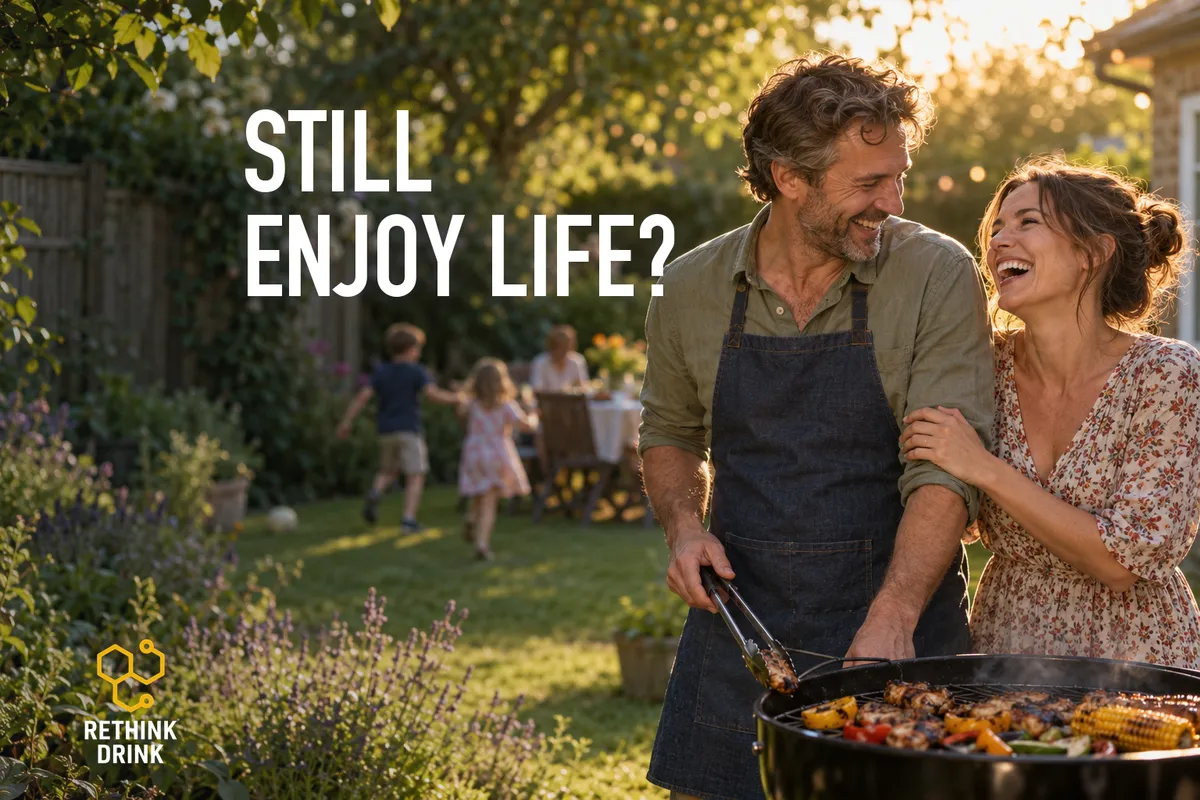
But the things you're doing this for, like the barbecue or the run... They should still feel like yours.
...If they don't, that's not something to put up with. It's something to talk about, with your prescriber and coach.
Common questions
Does naltrexone cause anhedonia?
Some people report a flat, joyless feeling, and mood disorders are a listed side effect. Most don't. If it lasts, talk to your prescriber.
Is it the tablet or the drinking that makes me feel flat?
Either, or both. Heavy drinking is linked with low mood and lost enjoyment on its own, and cutting down can feel flat for a while too. Your prescriber can help you work out which.
I tried naltrexone before and didn't like how it felt. Will it be the same?
Not necessarily, but don't assume. Tell your prescriber how you took it last time and what you noticed.
Does the flat feeling go away?
Some people say it eases, but there's little good research on how often or how fast. Don't wait it out alone: tell your prescriber.
Can I take naltrexone with antidepressants?
That's a question for your prescriber, who knows your full medicine list. See our post on naltrexone and other medicines.
If you'd like support from us
Rethink Drink is a UK coaching service built around The Sinclair Method. Our programmes include a consultation with an independent prescriber, who decides whether treatment is suitable. Clinical oversight is provided by consultant psychiatrist Professor Jonathan Chick. Any prescription is dispensed by an independent partner pharmacy. Our coaches work with you, week by week, on everything around it.
And whatever happens, you can talk to someone today. Drinkline, the national alcohol helpline, is free and confidential: 0300 123 1110.
Please look after yourself
This page is here to help you understand your options. It isn't medical advice, and it can't replace a conversation with a doctor who can ask qualifying questions.
Before you change how much you drink or start any medication, speak to your GP or a prescriber.
If you're struggling with low mood or thoughts of harming yourself, Samaritans are free, any time, on 116 123.
We really hope this post helps. If you have any questions, you can contact us here.
The Rethink Drink team
Sources
MHRA Products. Adepend 50 mg film-coated tablets (naltrexone hydrochloride): patient information leaflet, listed with the other UK naltrexone products. products.mhra.gov.uk
Berridge KC, Kringelbach ML. Pleasure systems in the brain. Neuron, 2015;86(3):646-664. https://pmc.ncbi.nlm.nih.gov/articles/PMC4425246/
Koob GF. Addiction is a reward deficit and stress surfeit disorder. Frontiers in Psychiatry, 2013;4:72. https://doi.org/10.3389/fpsyt.2013.00072
Garfield JBB, Lubman DI, Yücel M. Anhedonia in substance use disorders: a systematic review of its nature, course and clinical correlates. Australian and New Zealand Journal of Psychiatry, 2014;48(1):36-51. https://research.monash.edu/en/publications/anhedonia-in-substance-use-disorders-a-systematic-review-of-its-n/
Genazzani AR and colleagues. Central deficiency of beta-endorphin in alcohol addicts. Journal of Clinical Endocrinology and Metabolism, 1982;55(3):583-586. https://pubmed.ncbi.nlm.nih.gov/6284787/
Roschina OV and colleagues. Beta-endorphin and oxytocin in patients with alcohol use disorder and comorbid depression. Journal of Clinical Medicine, 2021;10(23):5696. https://pmc.ncbi.nlm.nih.gov/articles/PMC8658665/
Boecker H and colleagues. The runner's high: opioidergic mechanisms in the human brain. Cerebral Cortex, 2008. Summary: https://www.sciencedaily.com/releases/2008/03/080303101110.htm
Daniel M, Martin AD, Carter J. Opiate receptor blockade by naltrexone and mood state after acute physical activity. British Journal of Sports Medicine, 1992;26(2):111-115. https://bjsm.bmj.com/content/26/2/111
Siebers M and colleagues. Exercise-induced euphoria and anxiolysis do not depend on endogenous opioids in humans. Psychoneuroendocrinology, 2021;126:105173. https://pubmed.ncbi.nlm.nih.gov/33582575/
Gosnell BA, Levine AS. Reward systems and food intake: role of opioids. International Journal of Obesity, 2009;33(Suppl 2):S54-S58. https://www.nature.com/articles/ijo200973
Price RC and colleagues. Opioid-receptor antagonism increases pain and decreases pleasure in obese and non-obese individuals. Psychopharmacology, 2016;233(23-24):3869-3879. https://experts.umn.edu/en/publications/opioid-receptor-antagonism-increases-pain-and-decreases-pleasure-/
Mallik A, Chanda ML, Levitin DJ. Anhedonia to music and mu-opioids: evidence from the administration of naltrexone. Scientific Reports, 2017. https://www.mcgill.ca/newsroom/node/26679
Inagaki TK, Ray LA, Irwin MR, Way BM, Eisenberger NI. Opioids and social bonding: naltrexone reduces feelings of social connection. Social Cognitive and Affective Neuroscience, 2016;11(5):728-735. https://teams.semel.ucla.edu/sites/default/files/publications/Opioids%20and%20social%20bonding.pdf
O'Brien CP, Gastfriend DR, Forman RF, Schweizer E, Pettinati HM. Long-term opioid blockade and hedonic response: preliminary data from two open-label extension studies with extended-release naltrexone. American Journal on Addictions, 2011;20(2):106-112. https://pmc.ncbi.nlm.nih.gov/articles/PMC3895092
Drinkaware. Alcohol and depression. https://www.drinkaware.co.uk/facts/health-effects-of-alcohol/mental-health/alcohol-and-depression
Samaritans. Talk to us by phone. https://www.samaritans.org/how-we-can-help/contact-samaritan/talk-us-phone/