Thinking About Alcohol: The Mental Load of 'Grey Area' Drinking
If you spent the last three hours of your working day negotiating with yourself about whether you are allowed a drink tonight, you are already familiar with the mental load of grey area drinking.
Perhaps you are not physically dependent. You do not have a classic rock bottom story. You go to work, look after your family, and keep up appearances.
But the mental noise is exhausting.
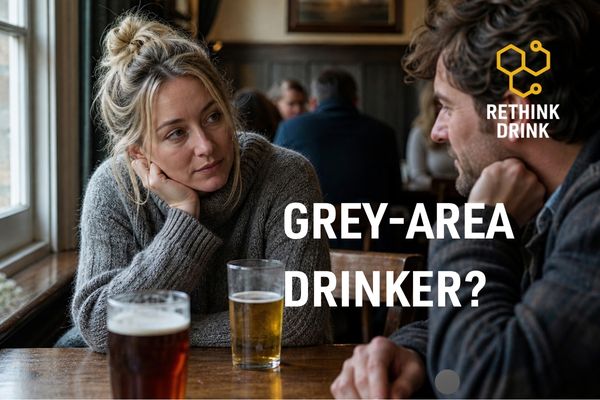
Grey area drinking refers to a pattern of alcohol consumption that sits between light social use and severe dependence. It is characterised by a heavy mental load: a constant internal negotiation about when, where, and how much to drink that consumes significant daily cognitive energy.
The Constant Negotiation: Inside the Mind of a Grey Area Drinker
For a grey area drinker, the real exhaustion rarely comes from a physical hangover. It comes from the rules.
You likely have a complex, ever-shifting set of boundaries designed to prove you are in control. These rules look familiar to many:
"I will only drink on weekends."
"No alcohol before 8 PM."
"I am only allowed two glasses tonight."
"I will only drink premium wine, because that means it is not a habit."
This constant rule-setting requires immense cognitive energy. You are running a heavy background programme in your mind all day. You plan when you will buy the alcohol, how you will space out your drinks, and how you will manage the guilt tomorrow.
By the time you actually pour the glass, your brain has already spent hours in a state of high tension. The mental RAM spent planning, resisting, and feeling guilty about drinking is far more exhausting than the physical drink itself.
Why Your Brain Won't Shut Up About Alcohol (The Neuroscience of Anticipation)
It is incredibly common to assume that this constant chatter is a sign of weak willpower or a flawed character.
It is not.
It is a biological conditioned response. Your brain has simply learned a pattern, and it is executing it perfectly.
When you use alcohol to mark the transition from the stress of the day to the relaxation of the evening, your brain releases a hit of endorphins. Endorphins are not actually the chemical of pleasure; it is the chemical of anticipation. It is the brain's way of saying: "Pay attention, this is important, make sure we do this again."
Over time, your brain builds deep neurological pathways that associate the evening transition with that endorphin spike. When that transition arrives, your brain begins playing the "alcohol channel" in the background of your mind. It is searching for the expected reward.
If you want to know how to stop thinking about alcohol, you must first understand that you are not fighting your moral character. You are fighting an endorphin-driven cue-and-reward loop.
Why 'White-Knuckling' Only Makes the Obsession Stronger
When people try to change their drinking, their first instinct is usually to use sheer willpower. They decide to stop drinking completely, relying on effort to stay dry.
In psychology, there is a concept known as "ironic process theory." If you are told not to think about a pink elephant, your brain must constantly check to make sure you are not thinking about it. In doing so, the image of the pink elephant becomes locked in your mind.
The same thing happens with white-knuckle abstinence. When you declare alcohol completely forbidden, you inadvertently increase its perceived value. It becomes the ultimate reward that you are denying yourself.
The mental chatter gets louder. The negotiation cycle becomes more intense. You might successfully avoid drinking for a week, or even a month, but the mental load remains incredibly high because the underlying neurological pathway is still fully intact.
How to Actually Quiet the 'Alcohol Noise'
To turn down the volume on the alcohol channel, you have to address the neurological pathways directly. This is where The Sinclair Method (TSM) comes in.
TSM is a medically supported, evidence-based approach that acts as a neurological mute button. It uses a prescription-only medication, taken strictly one hour before you drink, to block the endorphin receptors in your brain.
The process works step-by-step:
Targeted Blockade: You take the medication only on days you intend to drink, one hour beforehand.
Reward Removal: When you drink, the endorphins cannot bind to their receptors. The chemical "switch-off" reward is blocked.
Unlearning: Your brain expects a reward but receives nothing. This is called pharmacological extinction.
Extinction: Over time, through repeated exposure without reinforcement, the brain naturally forgets the urge to drink.
The goal is not to force yourself to resist alcohol. The goal is to make your brain indifferent to it, so you simply do not think about it in the first place.
Reclaiming Your Mental RAM with Rethink Drink
Imagine what your life would look like if you could claw back 30% of your daily mental capacity.
Imagine finishing work and naturally choosing to go for a walk, cook a meal, or read a book, without ever having to negotiate whether you are allowed a drink.
At Rethink Drink, our programmes are designed to help you transition from constant negotiation to effortless control. We combine the biological tools of pharmacological extinction with targeted coaching to help you rebuild your routines, manage stress without alcohol, and successfully navigate real life.
The medication addresses the chemistry. Our coaching addresses the life.
If you want to find out if this approach fits your lifestyle, explore our self-assessment page: Is Rethink Drink Right For Me.
Frequently Asked Questions
How long does it take for the mental "alcohol noise" to stop with TSM?
Every brain learns and unlearns at a different pace. Most clients begin to notice a subtle reduction in the intensity of their cravings within the first few weeks, while complete pharmacological extinction typically takes several months of consistent compliance.
Do I have to quit drinking entirely on The Sinclair Method?
No. TSM allows you to continue drinking while your brain undergoes the unlearning process. Some people use TSM to reach a state of safe, moderate social drinking, while others find that once the mental noise quietens, they naturally choose to stop drinking entirely.
How can I start this process?
You can read real-world success stories on our page for The Sinclair Method reviews, or take the first step today by booking a free, confidential Discovery Call with our team.