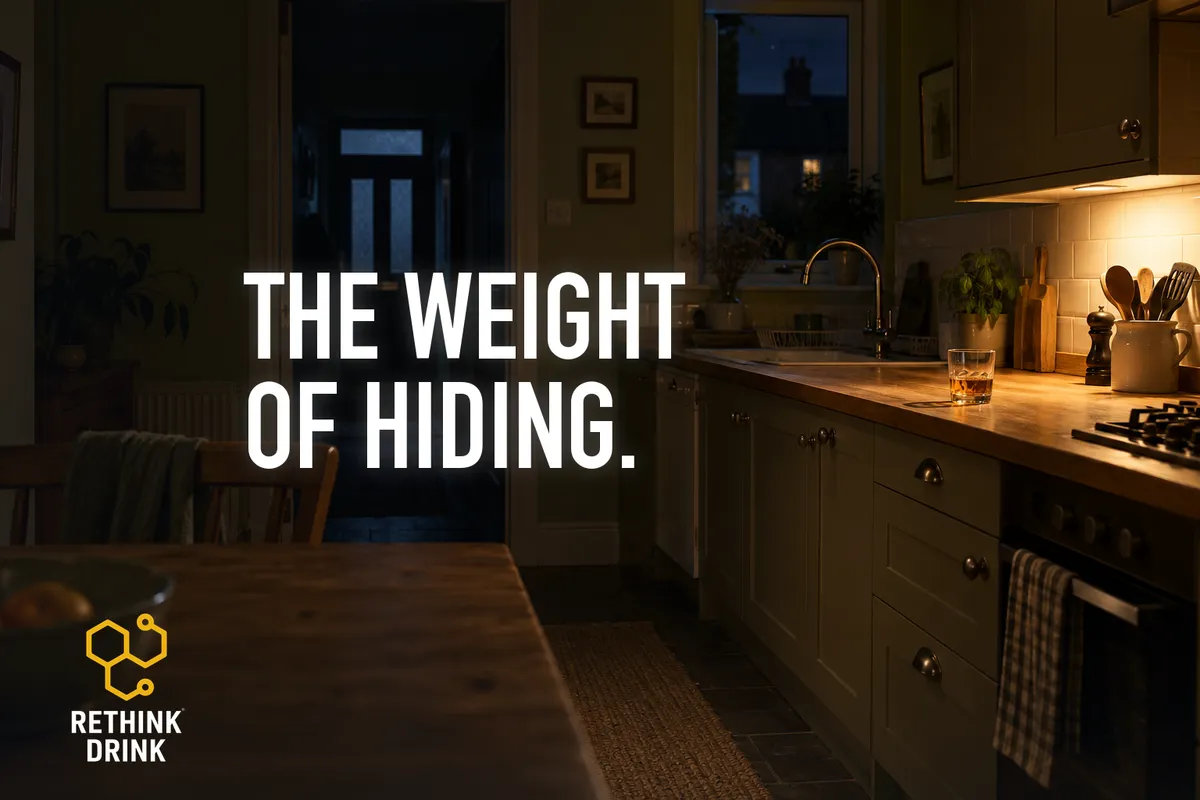
Hiding Your Drinking From Your Partner: Is It Time to Tell Them?
By Rethink Drink.
If you're hiding your drinking from your partner, you're not a bad person. And you're far from the only one.
Hiding usually starts as a way to protect someone... and ends up being one of the reasons you keep drinking.
Telling them can take a huge weight off. There are kind, safe ways to do it, and you don't have to do it tonight.
Most people who hide their drinking don't look like they have a problem.
They're holding it all together. Going to work. Doing the school run. From the outside, they look like they're doing well...
...But inside, they're crumbling.
That was Matt, our co-founder. In his words: "From the outside, I looked fine. Inside, I was becoming a shell of myself."
Maybe you've already tried to sort this out on your own.
You stopped for a while. Did well. Then one drink because there was an occasion... and before you knew it, you were back where you started. Only now it feels harder to say out loud, because you'd have to say again.
Matt knows that feeling. His longest stretch without a drink was six months. Then he went back to drinking more heavily than ever.
...And he hid more than ever.
In short
Hiding is common, and it's a signal, not a verdict. It tells you something has changed in your relationship with alcohol. It doesn't make you a liar or a bad person.
Hiding feeds the drinking. The stress of keeping it secret, and the shame that comes with it, become more reasons to reach for a drink.
Telling your partner can lift a massive weight. Pick a calm, sober moment, tell the truth, and say what you want: help.
You don't have to start with your partner. Your GP or a helpline can be a first step. But secrecy has a cost, the longer it runs.
Safety first. If you're worried about how anyone at home might react, get support before you have this conversation. Numbers are below.
Partners need support too. There's a note for them at the end.
What does hiding your drinking look like?
Hardly anyone sets out to be a secret drinker. It creeps in.
It can look like:
Waiting until everyone's gone to bed, then having "a couple more".
Drinking in the car, or a stop at the shop on the way home that nobody knows about.
Topping up the bottle, or replacing it before anyone notices it's gone.
Switching to spirits, because they're quicker and easier to hide than a few bottles of wine.
Empties in a different bin, or taken to the bottle bank yourself.
Shaving the number down when someone asks how much you've had.
For Matt, it was the van. Finishing work, getting in, and the vodka stop at the shop on the way home. That drive home was one of his biggest triggers.
And when his GP asked how much he was drinking, he halved the number... Even that got a worried look.
On calls, people often tell us: "I'm a quiet drinker. No one knows."
One honest line, because Matt has been there: he lost his licence for drink-driving.
Drink-driving is illegal and puts lives at risk. Being in charge of a car while over the limit is an offence too, even when you're not driving it.
Why do people hide their drinking?
Almost never because they're sneaky people.
Shame. Hiding it means nobody has to see it... including you.
Broken promises. "Monday will be different." When you've said it before and it didn't happen, saying it again feels unbearable. So you stop saying it, and start hiding it.
You think you're protecting them. Matt told himself he was hiding it to protect his wife, Dani. That he didn't want to hurt her.
In reality, it meant he drank without her knowing.
"Once I say it, I've got a problem for ever." Saying it out loud feels like signing up to a label for life. In a 2022 UK interview study, some heavy drinkers described resisting the idea that they had a problem at all, because the all-or-nothing "alcoholic" picture felt too severe to be them. Matt wrote about that in Once an alcoholic, always an alcoholic: really?
It's become a friend. The drink at the end of the night can be the one bit of the day that feels like yours. Admitting it's a problem can feel like losing that too.
Does hiding it make me a liar?
This is the one we most want you to hear.
You're not a liar. You're not a bad person. The drinking made you behave like that.
That isn't an excuse... It's an explanation.
When you've come to rely on alcohol, hiding becomes a way of protecting it. The hurt that causes is real... but it isn't the whole of who you are.
And that's where ownership starts. Not "I'm a bad person", but "this is what drinking has been doing to me, and I want it to stop".
Why does hiding make you drink more?
You'd think getting away with it would feel like relief.
... It doesn't. The lie needs relief.
It's hard to remember your own lies. Hard to remember where you put things. Hard to keep your stories straight. Hard to have a conversation the next day when you can't remember what was said the night before.
That's stress on top of stress. And for Matt, stress was already one of his biggest triggers.
The weight of a secret. Across ten studies of more than 13,000 secrets, psychologists at Columbia University found what hurt people's wellbeing wasn't the moments they had to actively hide something. It was how often their mind drifted back to it, uninvited (Slepian and colleagues, 2017).
That's secret drinking all over. You're not just hiding it at 11pm... You're carrying it ALL day.
Shame and relapse. In a Canadian study, newly sober people were filmed talking about the last time they drank and felt bad about it. The ones who showed more shame in their body language (slumped shoulders, a narrowed chest) were more likely to drink again in the following months, and drank more when they did (Randles and Tracy, 2013).
Put those together and you get a loop.
You drink. You hide it. The hiding weighs on you. You feel worse about yourself. And a drink is the quickest fix for feeling bad about yourself.
Secrecy increases stress, and stress increases drinking.
What happened when Matt told his wife?
In Matt's words: "My drinking was the most damaging thing in our relationship. It was what we argued about. It was like another person in our relationship."
When Matt found The Sinclair Method, he decided to be honest with Dani. Fully honest.
He wiped the slate clean. He told her what he'd actually been drinking. What she was unaware of. Where he was mentally. And that he wanted help.
Then he made a promise. Not "I'll never drink again"... He'd broken that one too many times.
He promised to be honest from that point forward.
In his words: "Once all the cards were on the table, a massive pressure disappeared. No more tracking stories. No more cover-ups. No more trying to remember what I'd done."
He talked about this on camera at the time, in Why being honest made my Sinclair Method journey easier. It's one of nine videos he recorded in his early months.
And something he didn't expect... It changed what he did with his feelings.
Before, his way of dealing with anything was to drink. Upset, angry, stressed, even a good day.
In his words: "Talking openly to Dani was something I never used to do. Now I was having the conversations I'd been avoiding for years."
A few months in, Matt had a real wobble. A long day in the workshop, no lunch, and his head locked on to the vodka stop on the way home.
The old Matt would have hidden that.
...Instead, he drove straight home and told Dani what had happened.
That alone took a huge amount of "need" out of the equation. (He tells the full story of that day in How long does The Sinclair Method take to work?)
That's Matt's experience, certainly not a promise of yours. But honesty was part of it from the start.
Should I tell my partner?
In most cases, we'd say yes. In your own time, and in a way that's safe for you.
Not everyone tells their partner first, and that's OK. Some people start with their GP or a helpline. Either is a real step.
But be honest with yourself about the cost of waiting.
Every week it stays hidden is another week of stress... and of the drink that eases it.
If the fear is about your safety, read "What if it isn't safe to tell them?" first.
How do I tell my partner I have a drinking problem?
You don't need perfect words. You need a calm moment and the truth.
Pick your moment.
When you're sober. Not after a drink "for courage".
Not in the middle of a row, or the morning after the worst night.
When there's time to talk and the kids aren't around.
If it helps, set it up first: "There's something important I want to talk to you about. Can we have some time tonight?"
Say it plainly. Something like this is enough:
"I've been drinking more than I've let you see. I've been hiding it, and I'm sorry. It's been around ____ a day / a week. I don't want to carry on like this, and I want help. I'm telling you because I want to be honest with you from now on."
You don't have to use a label.
Tell the whole truth. Matt halved his numbers with his GP... A half-confession usually means a second, harder conversation later.
Promise honesty, not perfection. "I'll never drink again" is a promise a lot of us have broken. "I'll be honest with you" is one you can keep.
Have a next step ready. A GP appointment you've booked, or a call to Drinkline (the number's at the end of this page). It gives your partner something to hold on to.
If face to face is too much, write it down. A letter still counts.
What should I expect when I tell them?
We can't promise you a reaction. But these are common:
Relief. Sometimes they already knew, or suspected, and the not-knowing was the hardest part for them too.
Hurt or anger. About the drinking, and often more about the hiding. Let them say it.
Lots of questions. How much? How long? Where? Answer honestly, even the uncomfortable ones.
Fear. About your health, and about what happens next.
Trust doesn't come back in one conversation. It comes back the same way it went... a bit at a time, through promises kept.
Talk about what support looks like. You want them on your side, not checking the bins.
They've been living with this too, and may need their own support. There's a note for them at the end.
What if it isn't safe to tell them?
If you're afraid of how your partner might react, or anyone at home has ever been hurt, threatened or frightened, your safety comes first. Don't have this conversation alone.
National Domestic Abuse Helpline (run by Refuge, for women): 0808 2000 247. Free, confidential, 24 hours a day.
Respect Men's Advice Line (for men): 0808 8010 327.
The NHS lists more helplines, including for LGBT+ people, on its page about getting help for domestic violence.
In an emergency, call 999. If you can't speak, call 999 from a mobile, cough or tap if you can, and press 55 when prompted (the police call this the Silent Solution).
And if drinking has ever made you frightening to be around, there's help for that too, without judgement: the Respect Phoneline is free on 0808 802 4040.
Common questions
Is secret drinking a sign of alcoholism?
It isn't a diagnosis on its own. But regularly hiding how much you drink from the person you share your life with is worth listening to. A better question than "am I an alcoholic?" is: can I keep the promises I make myself about drinking?
Our free units calculator and AUDIT-C check give you a starting picture in a couple of minutes...
...If you drink every day, or get shaky, sweaty or anxious without a drink, speak to your GP before you cut down. Our guide on whether you need a detox explains why.
Should I tell my partner everything at once?
One honest conversation is often easier than a drip-feed of confessions. But you can pace it. What matters is that what you do say is true.
Can I get help without my partner knowing?
Yes. Your GP and Drinkline are confidential, and in many areas you can refer yourself to your local alcohol service.
What if they want me to stop completely?
That's an understandable first reaction. Hear them out. Stopping completely is one real option, and cutting down is another; a GP or local alcohol service can talk them through with you both. Our guide to alcohol treatment in the UK sets out every route side by side.
If you'd like support from us
Rethink Drink is a UK coaching service built around The Sinclair Method. Our programmes include a consultation with an independent prescriber, who decides whether treatment is suitable for you. Any prescription is dispensed by an independent partner pharmacy. Our coaches work with you, week by week, on everything around it.
And whatever happens, you can talk to someone today. Drinkline, the national alcohol helpline, is free and confidential: 0300 123 1110.
Please look after yourself
This page is here to help you understand your options. It isn't medical advice, and it can't replace a conversation with a doctor who can ask qualifying questions.
Before you change how much you drink or start any medication, speak to your GP or a prescriber.
If you're struggling with low mood or thoughts of harming yourself, Samaritans are free, any time, on 116 123.
We really hope this post helps. If you have any questions, you can contact us here.
The Rethink Drink team
P.S. If you're reading this as the partner, you're not imagining how heavy it feels. Start with our page on how to support a loved one, where you can download our free Family Support Guide. And if you're not sure yet whether there's a problem, read Worried about someone else's drinking? Al-Anon Family Groups also offers support for families and friends.
Sources
Slepian ML, Chun JS, Mason MF. The experience of secrecy. Journal of Personality and Social Psychology, 2017;113(1):1-33. https://www.columbia.edu/~ms4992/Pubs/in-press_Slepian-Chun-Mason_JPSP.pdf
Randles D, Tracy JL. Nonverbal displays of shame predict relapse and declining health in recovering alcoholics. Clinical Psychological Science, 2013. https://www.psychologicalscience.org/news/releases/shame-about-past-alcoholism-predicts-relapse-and-declining-health-in-recovering-alcoholics.html
Morris J, Moss AC, Albery IP, Heather N. The "alcoholic other": harmful drinkers resist problem recognition to manage identity threat. Addictive Behaviors, 2022;124:107093. https://doi.org/10.1016/j.addbeh.2021.107093
GOV.UK. Drink-driving penalties. https://www.gov.uk/drink-driving-penalties
THINK! (Department for Transport). Drink driving. https://think.gov.uk/law/drink-driving
NHS. Alcohol support (Drinkline, Al-Anon Family Groups). https://www.nhs.uk/live-well/alcohol-advice/alcohol-support/
NHS. Getting help for domestic violence and abuse. https://www.nhs.uk/live-well/getting-help-for-domestic-violence/
Refuge. National Domestic Abuse Helpline. https://nationaldahelpline.org.uk
NHS Scotland (Ferguson Medical Practice). Respect Men's Advice Line. https://fergusonmedicalpractice.scot.nhs.uk/help-and-support/respect-mens-advice-line/
NHS 111 Wales. Respect Phoneline (local services directory). https://111.wales.nhs.uk/LocalServices/ViewLocalService.aspx?id=2962