Hangxiety: Why Does Drinking Leave You So Anxious?
By Rethink Drink. For UK adults. Reviewed November 2026.
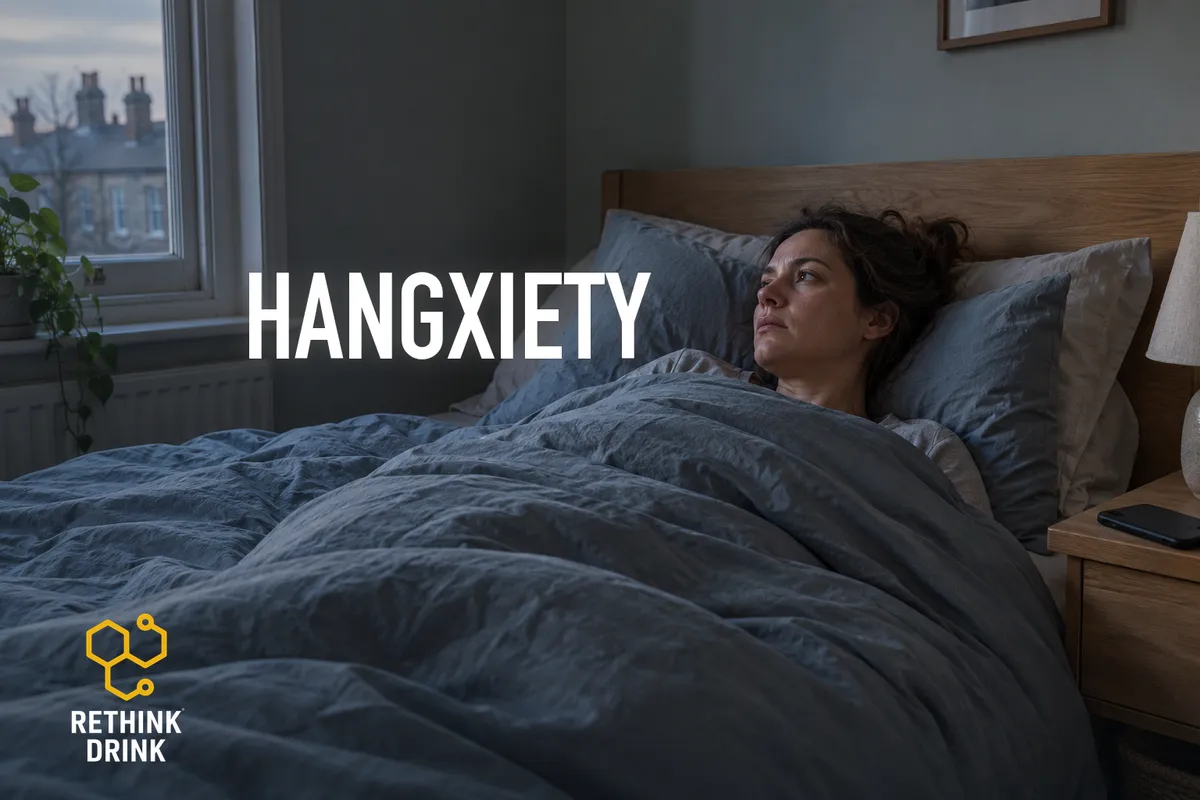
Hangxiety is the anxiety, dread or low mood that can come with a hangover.
Alcohol calms you down for a while. Then, as it wears off, your brain swings the other way... and you wake up wired, on edge, replaying everything you said.
Add a poor night's sleep, a hazy memory and a body that's short of water, and the morning after can feel a lot worse than the night was worth.
If you drink to take the edge off a stressful day, it can quietly turn into a loop. Drink to relax. Wake up anxious. Feel worse. Drink to relax.
On calls, people tell us a drink "gives me comfort", or that it "takes the boredom away". It does, for an hour or two. This page is about what it costs the next day, and how to get off that loop.
In short
Hangxiety is real. Anxiety and low mood are recognised hangover symptoms, not just guilt about the night before.
It's partly a rebound. Alcohol boosts the brain's calming chemistry and dampens the alerting side. As it wears off, the brain overcorrects, and that can feel like anxiety.
Some people get it much worse. In one study, very shy people felt calmer while drinking but much more anxious the next morning, and that was linked with more signs of an alcohol problem.
Drinking to cope can make anxiety worse over time. The relief is short-lived, and relying on it can mean drinking more.
Anxiety, shaking and sweating when you go without can be withdrawal, not a hangover. If you need a drink in the morning to settle your nerves, talk to your GP (General Practitioner).
What helps: time, water, food and rest on the day, and drinking less, sleep and support over the longer run.
What is hangxiety?
It's the anxious side of a hangover. That knot in your stomach. The sense that something's wrong, even when nothing is.
Ireland's health service, the HSE, lists "anxiety or feeling down" among the symptoms of a hangover, alongside the headache, the thirst and the shakes.
Why does alcohol make me anxious the next day?
There are a few things going on at once.
The rebound. Alcohol is a depressant. It boosts GABA, the brain's main calming chemical, and dampens glutamate, which keeps you alert. That's the relaxed, softened feeling. As the alcohol wears off, the brain rebalances by lowering GABA and raising glutamate... and the result can be a brain that's more on edge than before you started (researchers at Swinburne University, Aitken and Rothman, 2024).
The HSE puts it simply: alcohol boosts the brain's feel-good chemicals while you're drinking, and the changes in those chemicals can leave you feeling low afterwards.
Poor sleep. Alcohol can disrupt your sleep, even if you dropped off quickly. Passing out isn't sleep. You wake up tired, and tired brains worry more.
Your body. A hangover can mean dehydration, low blood sugar, a faster heartbeat, shaking and sweating (HSE). Those feel a lot like anxiety, and your brain can read them as a sign that something's wrong.
The gaps. Not remembering exactly what you said or did is a recipe for going over it again and again. "Did I say that? Did I upset someone? Why did I send that?"
Why do some people get hangxiety worse than others?
Researchers at UCL and the University of Exeter tested this with almost 100 social drinkers, some very shy and some not (Marsh and colleagues, 2018).
They were tested at home. Some were given around six units of alcohol; others stayed sober.
In the very shy people, the drinks eased their anxiety a little that evening. The next morning, that relief gave way to a big rise in anxiety. And among the very shy people, worse hangxiety was strongly linked to higher scores on the AUDIT, a test used to spot alcohol problems.
Read that again.
The people who got the most relief at night paid for it most in the morning. And they were the ones more likely to be showing signs of a drinking problem.
The Swinburne researchers add that people who already live with anxiety seem especially vulnerable.
Does alcohol cause anxiety, or do anxious people drink?
Both. And they feed each other.
The Mental Health Foundation says alcohol can give "a very short-lived feeling of relaxation" that quickly disappears. Relying on it to manage anxiety can mean drinking more over time, and can lead to dependence. It also says long-term drinking reduces the brain chemicals that help protect against anxiety and depression.
So if you've been using a drink to manage your nerves, you're far from alone. It isn't a character flaw. It's one of the most common coping habits in the country.
It just doesn't work for long.
Drinking to relax, but feeling more stressed?
This is the loop a lot of the people we work with are stuck in.
A hard day. A drink to switch off. It works... for a bit.
Then a broken night. A wired, guilty morning. A harder day, because you're running on empty.
And by the evening, the quickest fix you know is the same one that started it.
If you keep promising yourself a quieter week and it keeps ending the same way, that gap between what you meant to do and what happened becomes its own source of stress. And a reason to drink.
...We've written about that cycle in No willpower to stop drinking? and Why do I drink every night?
The hidden stress most people miss: broken promises to yourself
This is the piece that hits hard for grey-area drinkers. The stress is not only biochemical. It is psychological. Emotional. Identity-based.
Every time you say:
"I'm not drinking in the week."
"I'll just have two."
"I'm cutting back after this weekend."
"I'm definitely not doing this again."
"I need to get a grip."
...and then do not follow through, it creates internal tension. That tension matters. Because now it is not just about alcohol. It becomes about self-trust. About feeling inconsistent. About the private disappointment nobody else fully sees.
From the outside, things may still look fairly normal. You may still be functioning. Holding down work. Showing up. Smiling. But internally, there is a friction cost.
Alcohol creates stress.
Stress creates the urge to escape.
Alcohol becomes the escape.
Then the consequences of drinking create more stress.
Then the promises get broken again.
Then the loop tightens.
Is it hangxiety, or alcohol withdrawal?
This matters, so please read it.
Anxiety, trouble sleeping, sweating, shaking, nausea and a racing heart are also symptoms of alcohol withdrawal. The NHS says withdrawal symptoms are a sign your body is dependent on alcohol, and that they typically start 6 to 12 hours after your last drink.
Some signs that it may be more than a hangover:
You feel this way most mornings, not just after a big night
A drink in the morning settles you down
You get shaky, sweaty or panicky whenever you go without
If that sounds familiar, don't stop suddenly. The NHS says it can be very dangerous to stop drinking suddenly if you're dependent on alcohol.
Check first: if your body depends on alcohol, stopping or cutting down too fast can be dangerous. Speak to your GP or local alcohol service before you change anything...
...Our free units calculator and AUDIT-C check give you a starting picture in a couple of minutes. They can't tell you whether your body depends on alcohol; a doctor can.
How do I get rid of hangxiety?
On the day, look after your body first. The HSE says only time gets rid of a hangover, but these help you through it:
Water. Plenty of it, through the day.
Plain food. Toast, crackers, a banana, something easy.
Rest. A nap if you can.
Not more alcohol. The HSE says another drink, the "hair of the dog", will not help your hangover. If a drink is the thing that settles the anxiety, that's worth paying attention to.
Then look after your head.
Slow your breathing, or try a short mindfulness exercise, especially if the worry is keeping you awake (Aitken and Rothman, 2024).
Write it down. Get the spiral out of your head and onto paper. Then ask: what would I say to a friend who felt like this?
Talk to someone you trust. Hangxiety feeds on isolation.
Go easy on yourself. Beating yourself up the morning after is the start of the loop, not the end of it.
How do I stop getting hangxiety?
The honest answer: drink less. No drink, no hangover.
That doesn't have to mean zero. It means finding out what's driving the drinking, and working on that.
Notice the pattern. Which nights lead to the worst mornings? What was going on before you poured the first one?
Get help with the anxiety itself. In England, you can refer yourself to NHS Talking Therapies for anxiety without seeing your GP first. It's free. Your GP can also help.
Get help with the drinking. Your GP or a local alcohol service can talk you through your options, including talking therapies, support groups and medication. If cutting down rather than stopping is your goal, What is The Sinclair Method? explains one route honestly, including what the evidence can and can't tell you.
Don't rely on willpower alone. If drinking is how you've been managing your nerves, taking it away without putting anything in its place rarely sticks.
Common questions
Why do I feel anxious after drinking?
As alcohol wears off, the brain rebounds from its calming effect, which can feel like anxiety. Poor sleep, dehydration, low blood sugar and patchy memories of the night all add to it.
How long does hangxiety last?
Usually as long as the hangover, which the HSE says typically passes within 8 to 24 hours. If anxiety hangs around for days, or is there most mornings, talk to your GP.
Does drinking make anxiety worse in the long run?
It can. The Mental Health Foundation says relying on alcohol for anxiety can mean drinking more over time, and that long-term drinking can deplete the brain chemicals that help protect against anxiety and depression.
Why do I feel guilty and ashamed after drinking?
Partly the brain chemistry, partly not remembering clearly, and partly the gap between what you meant to do and what you did. Guilt and remorse after drinking are also on the NHS's list of signs of alcohol-use disorder, so if it's regular, it's worth a conversation with your GP.
Is it OK to have a drink to get rid of hangxiety?
More alcohol doesn't fix a hangover, and needing a drink in the morning to settle your nerves can be a sign your body depends on alcohol. Please speak to your GP.
If you'd like support from us
Rethink Drink is a UK coaching service built around The Sinclair Method. Our programmes include a consultation with an independent prescriber, who decides whether treatment is suitable. Clinical oversight is provided by consultant psychiatrist Professor Jonathan Chick. Any prescription is dispensed by an independent partner pharmacy. Our coaches work with you, week by week, on everything around it.
And whatever happens, you can talk to someone today. Drinkline, the national alcohol helpline, is free and confidential: 0300 123 1110.
Please look after yourself
This page is here to help you understand what's going on and what your options are. It isn't medical advice, and it can't replace a conversation with a doctor who can ask qualifying questions.
Before you change how much you drink or start any medication, speak to your GP or a prescriber.
If you're struggling with low mood or thoughts of harming yourself, Samaritans are free, any time, on 116 123.
We really hope this post helps. If you have any questions, you can contact us here.
The Rethink Drink team
Sources
HSE (Health Service Executive, Ireland). Hangover. https://www.hse.ie/living-well/alcohol/health/how-alcohol-can-affect-everyday-life/hangover/
Aitken B, Rothman R (Swinburne University of Technology). Why do I get so anxious after drinking? Here's the science behind 'hangxiety'. The Conversation, December 2024 (republished by Daily Maverick). https://www.dailymaverick.co.za/article/2024-12-16-why-do-i-get-so-anxious-after-drinking-heres-the-science-behind-hangxiety.md
Marsh B, Morgan CJA and colleagues. Study of shyness, alcohol use disorder symptoms and hangover anxiety in social drinkers. Personality and Individual Differences (University College London news release, 6 December 2018). https://www.ucl.ac.uk/news/2018/dec/shy-people-more-prone-anxiety-during-hangovers
Mental Health Foundation. Alcohol and mental health. https://www.mentalhealth.org.uk/explore-mental-health/a-z-topics/alcohol-and-mental-health
NHS. Alcohol-use disorder (page last reviewed 24 April 2026). https://www.nhs.uk/conditions/alcohol-use-disorder/
NHS. NHS Talking Therapies, for anxiety and depression. https://www.nhs.uk/mental-health/talking-therapies-medicine-treatments/talking-therapies-and-counselling/nhs-talking-therapies/
Samaritans. If you're having a difficult time. https://www.samaritans.org/how-we-can-help/if-youre-having-difficult-time/