Alcohol Relapse: Sober for Months, Then One Drink... Now What?
By Rethink Drink. For UK adults. Reviewed November 2026.
An alcohol relapse is going back to drinking the way you used to, after a spell of stopping or cutting down.
It's common. Far more common than most people realise.
And it isn't a failure... It's information.
If you're reading this after weeks or months without a drink... We know how heavy that feels.
On calls, people often tell us a version of the same story.
They'd been sober for weeks. Sometimes months.
Then there was an occasion. A wedding, a birthday, a bad day at work.
"Do you want one?"
"I suppose I could have one."
... And within days, sometimes the same night, they were straight back to where they'd left off. Or worse.
If that's you, this page is for you. What relapse is, why it happens, why it doesn't wipe out the time you had, and what to do next... safely.
In short
Relapse is common. The US National Institute on Alcohol Abuse and Alcoholism says it's rare for someone to go to treatment once and never drink again. Setbacks are part of how most people get better.
A lapse isn't a relapse. One drink, or one night, is a lapse. A relapse is sliding back into the old pattern. What happens after the first drink matters more than the drink itself.
It isn't a willpower problem. Stress, low mood, boredom, someone offering you a drink, and what your brain has learned over years all play a part.
Your sober time still counts. The weeks or months you had are proof of what you can do. They don't disappear.
Be careful about stopping again. If you're back to drinking heavily every day, stopping overnight can be dangerous. Speak to your GP (General Practitioner) or local alcohol service first.
There are real options, including free NHS support you can often refer yourself to.
...If you're worried about your body right now, jump to "Check your body before you stop again" below.
What is an alcohol relapse?
There's no single medical definition. But psychologists who study relapse make one distinction that really helps...
A lapse is the first drink, or the first slip, after you've set yourself a goal.
A relapse is when that slip turns back into the full pattern.
The psychologist G. Alan Marlatt, whose work underpins a lot of modern relapse prevention, described relapse as a process: a series of events that unfold over time, rather than one moment (Larimer, Palmer and Marlatt, 1999).
That matters... Why?
Because a process can be interrupted. At the first drink, at the second, or the morning after.
How common is relapse?
Very.
The NIAAA puts it plainly: setbacks are common, and it's rare for someone to go to treatment once and never drink again. More often, people try to quit or cut back over time, have setbacks, and learn from them.
One of the longest studies we have followed 461 people in the US with alcohol problems for 16 years. Of those who had stopped drinking problematically by year three, 43% of the people who got help went on to relapse. For the people who didn't get help, it was 61% (Moos and Moos, 2006).
That's one study, from the US. But relapse happened to a LOT of people, whichever way they went... And getting help made a real difference.
So if you've relapsed... you're not unusual. You're far from alone.
Why did one drink turn into all of it?
One phrase comes up on our calls more than almost any other:
"I'm only in control of the first drink."
And we get it. Because that's exactly how it feels.
There are two big reasons it can go that way. One is in your head. The other is in your brain's wiring.
The "I've blown it now" effect
Marlatt gave it a name: the abstinence violation effect.
It's what happens in the moments after a lapse. You've broken the rule you set yourself... and your mind does the rest.
"I've blown it now."
"I might as well."
"I'll start again on Monday."
Marlatt's work found that people who see a slip as proof of personal failure tend to feel more guilt, and drink more. People who see it as a slip in coping, something that went wrong in a situation, are less likely to abandon their goal altogether.
Same drink. Different story about it. Different outcome.
The brain side
There's a biological piece too.
In 1967, David Sinclair, then a student, found that rats used to drinking alcohol drank more than before when it came back after a break (Sinclair and Senter, 1967). It's called the alcohol deprivation effect.
That was found in animals. How far it carries over to people is still debated. We've written about the science on its own page.
...See the alcohol deprivation effect
Why does relapse happen?
It's rarely one thing. But some situations come up again and again.
In Marlatt's research, negative feelings and conflict with other people were behind more than half of all the relapse episodes his team looked at. Social pressure, both being offered a drink and simply being around people who are drinking, was behind about one in five.
On calls, the ones we hear most:
Boredom. "Boredom kicks in." Life feels flat, and a drink fills the gap.
Stress. A hard day, and the old fix is right there.
An occasion. "One glass because there was an occasion..." and before you know it, it's a bottle.
Feeling better. After weeks off, it's easy to think "I've got this now."
A review of 321 studies (Sliedrecht and colleagues, 2019) found relapse was most linked to other mental health problems, how severe the drinking had been, craving, and health and social problems. What protected people was a supportive network, confidence in their own ability to cope, and a sense of purpose in life.
None of those are about willpower.
Isn't it just willpower?
This is the one we most want you to hear.
You have willpower. You use it everywhere else in your life.
And if you stopped for weeks or months... That took a LOT of willpower.
Drinking the way you did, over years, is a learned pattern in the brain.
You're not failing to control alcohol. Your brain is prioritising it.
...More on this in No willpower to stop drinking?
Is relapse a sign of failure?
No.
An NHS hospital's leaflet says it. The Alcohol Care Team at University Hospitals Coventry and Warwickshire tells patients in its relapse leaflet: it's okay if you relapse, don't feel guilty, because guilt will only hold you back.
The NIAAA says the same thing in different words: a return to drinking can be seen as a temporary setback, not a failure.
Here's the bit that does the damage, though.
It's the broken promises. "Monday will be different." "This is the last one." Every broken promise takes a bit more confidence and a bit more self-worth.
... And a drink is the quickest fix for feeling worthless. So the cycle feeds itself.
That's why how you talk to yourself after a relapse matters as much as anything else on this page.
A relapse doesn't erase the time you had sober. It's proof you can do it, and information about what got in the way.
What happened when Matt relapsed?
It happened to Matt, our co-founder... Over, and over.
His longest time was six months without a drink... and he thought he'd cracked it.
Six months and two weeks later, he was drinking again. Heavier than ever.
It turned into the heaviest period of his life. He lied more than ever. He hid more than ever.
In his words: "Back then I just thought I was failing."
He wasn't. He'd spent six months putting time between him and his last drink... But nothing about his relationship with alcohol had changed.
...The full story is in Once an Alcoholic, Always an Alcoholic: Really?
What should I do after a relapse?
Take a breath first. Then, in this order:
1. Check your body before you stop again
This is the one that keeps you safe.
If you've only had a drink or two, or one night, this is unlikely to be an issue.
But if you're back to drinking heavily, every day, your body can become dependent on alcohol again. And then stopping overnight can be harmful.
Signs your body may be depending on alcohol: feeling shaky, sweaty, anxious or sick when you haven't had a drink, especially in the morning, or needing a drink to feel normal.
If that's you, don't stop suddenly. Speak to your GP or your local alcohol service first, so you can cut down or stop safely, with medicine if you need it.
There's another reason to take this seriously. Research on withdrawal (Becker, 1998) suggests that repeated withdrawals can make later ones more severe. So stop-start, on your own, carries more risk each time round.
...See Do I need a detox first?
2. Tell one person
Relapse loves secrecy.
We know how hard this is.
Matt never used to talk openly to his wife, Dani. Later, when he had a wobble, he told her what had happened, that same day. In his words, "That was new for me."
You don't have to tell everyone. One person is enough. A partner, a friend, your GP, your sponsor, your coach.
Or a stranger who's trained for it: Drinkline, the free national alcohol helpline (the number is at the bottom of this page).
3. Look at what happened, not at who you are
Treat it like a detective, not a judge.
Where were you?
Who were you with?
What were you feeling in the hour before?
What did you tell yourself just before the first drink?
The Coventry leaflet puts it simply: think about what made you relapse, recognise your triggers, and use that to help you get better.
That's not a criticism of you. It's data.
4. Get support around you
In the 16-year US study above, people who got help were less likely to relapse than people who went it alone. It doesn't have to be the same support as last time. If something didn't fit before, that's useful to know too.
5. Look at your options again
Your GP. They can check your health, including your liver, and help you cut down or stop safely. ...See Can I get naltrexone from my GP or the NHS? for how to walk in prepared.
Your local alcohol service. Free, and in many areas of England you can refer yourself. The NHS has a service finder.
Support groups. Alcoholics Anonymous (AA) and SMART Recovery both run free groups, in person and online.
Medicines on the NHS. Acamprosate and naltrexone are first-choice NHS medicines for staying stopped. They're used daily, once you've stopped drinking, usually through your local service.
The Sinclair Method. A different method with a different goal. Naltrexone is taken before drinking, at a time your prescriber sets, so the desire for alcohol weakens over time and you drink less. It's outside naltrexone's UK licence, so it's usually through a private prescriber. ...See What is The Sinclair Method?
All the routes side by side: Alcohol treatment options in the UK
What if this keeps happening?
"This will be my fourth time."
"Back and forth, back and forth."
We hear this a LOT. People who've done AA, rehab, a home detox, an app... and keep ending up in the same place.
That was Matt, for close to two decades. Rules, counselling, CBT, SMART Recovery, AA, an anti-craving medication.
If that's you, try a different question.
Not "what's wrong with me?"
But "is the approach I keep using the right fit for me?"
Some people stop and stay stopped, and that's brilliant. For others, the stop, hold on, relapse cycle keeps repeating, and every lap costs a bit more.
There's more than one way to change your relationship with alcohol. ...See The Sinclair Method vs AA
Common questions
Is relapse normal?
Yes. Setbacks are common for people who change their drinking. It's rare for anyone to stop once and never drink again.
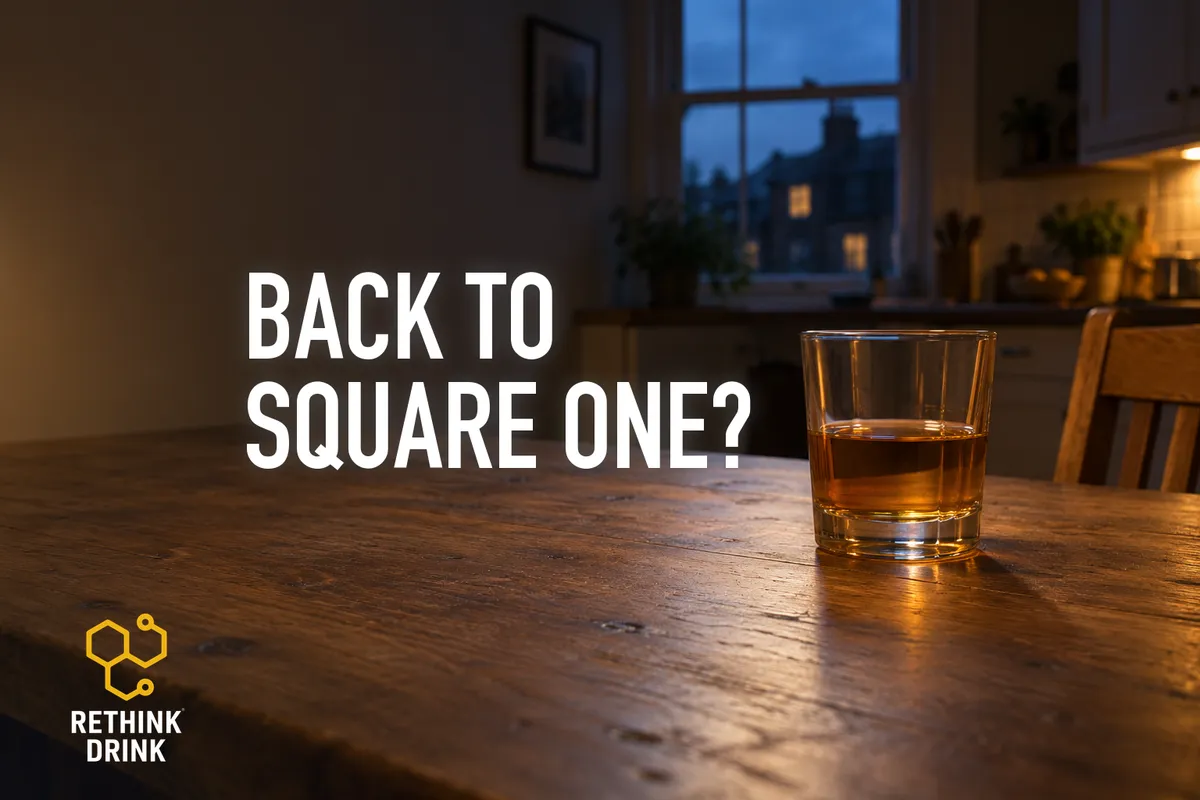
Does a relapse mean I'm back to square one?
No. You still have everything you learned while you were sober, and you know more now about what gets in the way. The time you had still counts.
Is it safe to just stop again tomorrow?
If you've had a drink or two, usually yes. If you're back to drinking heavily every day, stopping overnight can be dangerous. Speak to your GP or local alcohol service first.
Should I go back to my GP?
Yes, especially if you're drinking daily again or feel unwell when you stop. They can check your health and refer you to local support. You can often refer yourself, too.
Someone I love has relapsed. How can I help?
Stay calm, keep talking, and avoid ultimatums where you can. Our guide for families, Supporting a loved one, is a good place to start.
If you'd like support from us
Rethink Drink is a UK coaching service built around The Sinclair Method. Our programmes include a consultation with an independent prescriber, who decides whether treatment is suitable. Clinical oversight is provided by consultant psychiatrist Professor Jonathan Chick. Any prescription is dispensed by an independent partner pharmacy. Our coaches work with you, week by week, on everything around it.
And whatever happens, you can talk to someone today. Drinkline, the national alcohol helpline, is free and confidential: 0300 123 1110.
Please look after yourself
This page is here to help you understand relapse and your options. It isn't medical advice, and it can't replace a conversation with a doctor who can ask qualifying questions.
Before you change how much you drink or start any medication, speak to your GP or a prescriber.
If you're struggling with low mood or thoughts of harming yourself, Samaritans are free, any time, on 116 123.
We really hope this post helps. If you have any questions, you can contact us here.
The Rethink Drink team
Sources
National Institute on Alcohol Abuse and Alcoholism (NIAAA). Treatment for Alcohol Problems: Finding and Getting Help. https://www.niaaa.nih.gov/publications/brochures-and-fact-sheets/treatment-alcohol-problems-finding-and-getting-help
Larimer ME, Palmer RS, Marlatt GA. Relapse prevention: an overview of Marlatt's cognitive-behavioral model. Alcohol Research and Health, 1999; 23(2): 151 to 160. https://www.ncbi.nlm.nih.gov/pmc/articles/PMC6760427/
Moos RH, Moos BS. Rates and predictors of relapse after natural and treated remission from alcohol use disorders. Addiction, 2006; 101(2): 212 to 222. Summary: https://bu.edu/aodhealth/2006/05/01/natural-remission-and-relapse
Sliedrecht W, de Waart R, Witkiewitz K, Roozen HG. Alcohol use disorder relapse factors: a systematic review. Psychiatry Research, 2019; 278: 97 to 115. https://doi.org/10.1016/j.psychres.2019.05.038
University Hospitals Coventry and Warwickshire NHS Trust, Alcohol Care Team. Alcohol relapse prevention (patient leaflet, version 3.1, January 2025). https://www.uhcw.nhs.uk/download/clientfiles/files/Patient%20Information%20Leaflets/Medicine/Gastroenterology/Alcohol%20relapse%20prevention.pdf
NHS. Alcohol support. https://www.nhs.uk/live-well/alcohol-support/
Becker HC. Kindling in alcohol withdrawal. Alcohol Health and Research World, 1998; 22(1): 25 to 33.
Sinclair JD, Senter RJ. Increased preference for ethanol in rats following alcohol deprivation. Psychonomic Science, 1967; 8: 11 to 12. https://doi.org/10.3758/BF03330642
NHS. Find alcohol addiction support services. https://www.nhs.uk/nhs-services/find-alcohol-addiction-support-services/