Neural Pathways and Alcohol: How Drinking Habits Form
By Rethink Drink. For UK adults. Reviewed November 2026.
A neural pathway is a route your brain has learned by repetition. Walk the same way across a field every day and you wear a path. The brain does something similar.
Drink at the same time, in the same place, for the same reasons, often enough... and the brain wears a path to alcohol.
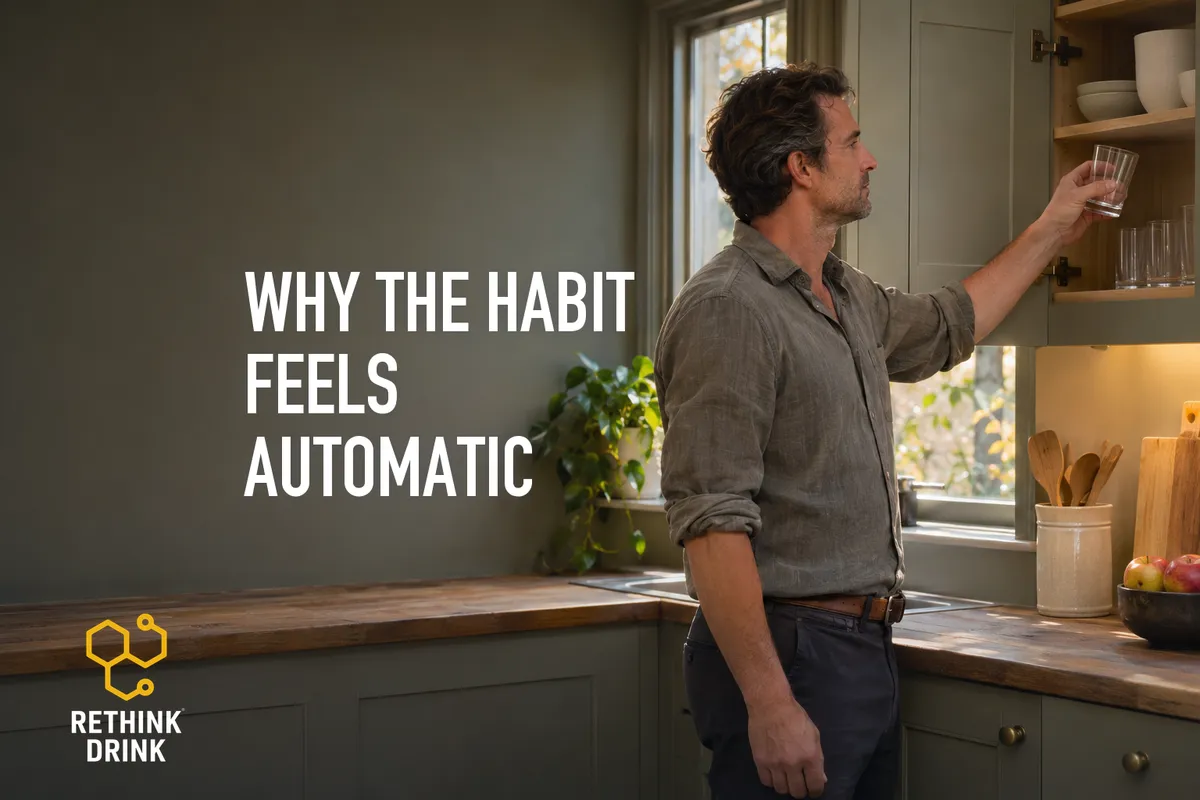
That's why drinking can start to feel automatic. Not a decision you make each evening. A route you're already halfway down before you've noticed.
The good news is that the brain keeps learning all your life. Paths that were learned can be relearned.
But here's the part most pages skip: the old path doesn't simply disappear. Knowing that can save you a LOT of heartache.
You might be here because you're curious how it works.
Or you might have stopped for weeks or months, had one drink, and found yourself straight back where you started.
In short
Drinking is learned. Each drink gives the brain a reward. Repeat it enough and it becomes a routine linked to times, places, people and feelings.
Habits move in the brain. Research suggests that with repetition, control shifts from the thinking, choosing parts of the brain towards areas that run habits on autopilot.
Cues start the wanting. The time of day, the fridge door, the end of a hard shift. The routine itself starts the urge before you've decided anything.
The old path stays. Learning not to do something adds new learning. It doesn't erase the old. That's why it can come back after a break.
New habits take time. In one study, it took a median of 66 days for a new daily habit to feel automatic, with a huge range between people.
The brain can recover. Studies of people who stop drinking show brain volume partly coming back over months.
Check first: if your body depends on alcohol, stopping or cutting down too fast can be dangerous. Speak to your GP (General Practitioner) or local alcohol service before you change anything...
...Our free units calculator and AUDIT-C check give you a starting picture in a couple of minutes. They can't tell you whether your body depends on alcohol; a doctor can.
What is a neural pathway?
Your brain learns by repetition. Each time a pattern repeats, it gets a little easier to repeat next time, until it barely needs any thought at all.
That's a neural pathway, or neuropathway. It's how you learned to ride a bike, drive a car, or type without looking at the keys.
The brain's ability to change these connections is called neuroplasticity. It's working all the time, for good habits and not-so-good ones.
How does alcohol create a neural pathway?
It starts with a reward.
When you drink, your brain releases endorphins, its own feel-good chemicals. They land on opioid receptors, and that's the reward. Brain scans have shown this happening in people as they drink (Mitchell and colleagues, 2012).
Every time that happens, the brain learns: that was worth it. Do it again.
...The full story of that reward is in Does alcohol release endorphins?
Then the brain starts linking the reward to everything around it.
The same drink. The same glass. The same seat. The same time.
The car journey home. The kids finally in bed. The feeling at the end of a long day.
Each of those becomes a cue. Researchers call them conditioned cues, and a major review of addiction research describes how cues linked to a drug have a "marked influence" on the behaviour of seeking it out (Everitt and Robbins, 2016).
In plain words... the routine itself starts the wanting.
Why does drinking start to feel automatic?
Barry Everitt and Trevor Robbins at the University of Cambridge have spent years studying how drug use changes the brain. Their idea, updated in that 2016 review, is that addiction can be seen as a shift from voluntary use to habit, and then to compulsion.
Underneath, they describe control moving from the parts of the brain that weigh up choices towards the dorsal striatum, a deeper area that runs habits.
It's worth knowing two things they point out:
Habits aren't a flaw. They describe habits as "an efficient mode of information processing". The brain automates what you do often, so you don't have to think about it. That's exactly why it's so useful for driving a car... and so unhelpful with a drink.
It applies to alcohol. They report that people who are dependent on alcohol show an over-reliance on habit-based responses.
Much of this research comes from animal studies, alongside human studies. It's a model, not the final word. But it fits what so many people tell us on calls:
"I'm only in control of the first drink."
"It started creeping in every day."
That's what a well-worn path feels like from the inside.
You're not failing to control alcohol. Your brain has learned to prioritise it.
...More on why this isn't a willpower problem: No willpower to stop drinking?
...And on the evening routine in particular: Why do I drink every night?
If I stop drinking, does the pathway disappear?
This is the bit that matters most, and it surprises a lot of people.
When you stop doing something you've learned, the brain doesn't delete the old learning. It adds new learning on top.
Psychologist Mark Bouton has spent decades studying this. In a 2002 review, he wrote that "extinction" (unlearning a response) "does not reflect a destruction of the original learning". The old learning "remains... ready to be retrieved by the right manipulation of context."
He describes three ways the old response comes back:
Renewal: a change of setting brings it back. The new learning is tied to where you learned it; the old path can return somewhere else.
Reinstatement: a brush with the original reward brings it back.
Spontaneous recovery: time passing brings it back.
Most of this research is on learned fear and learned behaviour in general, not alcohol alone. But it explains something people often feel ashamed of.
"Six months sober. Then one glass, because there was an occasion... and before I knew it, it was a bottle."
Time away put distance between you and your last drink. It didn't change the path. That's not weakness. It's how learning works.
...Read Alcohol relapse: the physical, mental and emotional challenges.
...And why one drink after a break can hit even harder: the alcohol deprivation effect.
How long does it take to change a habit?
You'll often hear "21 days". The research doesn't support a fixed number.
In a well-known UCL study, 96 volunteers picked a new daily eating, drinking or activity habit and tracked it for 12 weeks (Lally and colleagues, 2010). Among the people whose data fitted the researchers' model well, the median time to reach near-automatic was 66 days. The range ran from 18 days to an estimated 254.
Two things from that study are worth holding onto:
It varies hugely from person to person. Your timeline is yours.
Missing one day didn't undo the progress. A single slip barely dented how automatic the habit felt.
That was a study of building simple new habits around eating, drinking or exercise, not undoing years of drinking alcohol. So treat it as a guide to the shape of change, not a promise. It tends to be gradual. And it's rarely a straight line.
Can the brain recover from alcohol?
There's real cause for hope here.
A US study scanned the brains of 85 people who were dependent on alcohol, at one week, one month and seven months after they stopped drinking (Zou and colleagues, 2018).
Brain volume increased in five of the six regions they looked at.
Some areas at the front of the brain recovered along a curve over the months, rather than in a straight line.
It adds to earlier research describing these brain changes as "partially reversible" when people stop drinking.
This study was about stopping completely, and recovery varies between people. But it's a clear sign that the brain isn't stuck where it is.
So how do you change a neural pathway?
Not by fighting it harder every evening.
If habits run on cues, you change what's around the cues, and you change what the brain gets from the routine.
Notice the cues. What time? Where? Who with? What were you feeling just before? Treat it as information, not a verdict.
Change the ritual. Same drink, same glass, same seat, same time. Change one of them. A different chair. A different route home. Something else in your hand for the first ten minutes.
Meet the need underneath. Matt, our co-founder, had a wobble a few months into his own change. When he looked back at it, the lesson was that thirst and hunger had become triggers. Hydration and eating well became part of his routine... in his words, "taking care of myself for the first time in a long time".
Get support. Habits are hard to see from the inside. A coach, a group, a service or a friend can spot the pattern you're too close to see. Your GP can talk you through the support available on the NHS.
Know your options. Some people choose to stop completely, and that's a brilliant goal. Others want to cut down.
The route we work with, The Sinclair Method, aims at the reward itself. Naltrexone is taken before drinking, at a time your prescriber sets, so the endorphins have almost nowhere to land, which is how the reward cycle is interrupted. Over time, the brain can unlearn the reward through a process called pharmacological extinction. It's off-label in the UK, it isn't for everyone, and it needs support alongside.
And remember Bouton's point: unlearning is new learning, and context matters. Taking a tablet cannot change our habits. The routines, the triggers, the environment... that's the real work.
...How it works, honestly: What is The Sinclair Method?
...And why the work around the medicine matters so much: Why support is so important with The Sinclair Method.
Common questions
Can you rewire your brain from alcohol?
The brain keeps changing throughout life, so yes, new pathways can form. But research suggests the old learning stays in the background, which is why it can return after a break, especially in old settings.
How long does it take to break a drinking habit?
There's no fixed number. A study of new daily habits found a median of 66 days to become automatic, with a range from 18 to an estimated 254. Changing a drinking habit is often longer and rarely a straight line.
Why do I go straight back to my old drinking after a break?
Because stopping adds new learning; it doesn't erase the old. A drink, a familiar setting or simply time passing can bring the old pattern back.
Does the brain heal after you stop drinking?
Studies of people who stopped drinking show brain volume partly recovering over months. How much varies from person to person.
If you'd like support from us
Rethink Drink is a UK coaching service built around The Sinclair Method. Our programmes include a consultation with an independent prescriber, who decides whether treatment is suitable. Clinical oversight is provided by consultant psychiatrist Professor Jonathan Chick. Any prescription is dispensed by an independent partner pharmacy. Our coaches work with you, week by week, on everything around it.
And whatever happens, you can talk to someone today. Drinkline, the national alcohol helpline, is free and confidential: 0300 123 1110.
Please look after yourself
This page is here to help you understand what's going on and what your options are. It isn't medical advice, and it can't replace a conversation with a doctor who can ask qualifying questions.
Before you change how much you drink or start any medication, speak to your GP or a prescriber.
We really hope this post helps. If you have any questions, you can contact us here.
The Rethink Drink team
Sources
Everitt BJ, Robbins TW. Drug addiction: updating actions to habits to compulsions ten years on. Annual Review of Psychology, 2016; 67: 23 to 50. https://annualreviews.org/doi/pdf/10.1146/annurev-psych-122414-033457
Bouton ME. Context, ambiguity, and unlearning: sources of relapse after behavioral extinction. Biological Psychiatry, 2002; 52: 976 to 986. https://www.appstate.edu/~steelekm/classes/psy5150/Documents/Bouton2002.pdf
Lally P, van Jaarsveld CHM, Potts HWW, Wardle J. How are habits formed: modelling habit formation in the real world. European Journal of Social Psychology, 2010; 40(6): 998 to 1009. doi:10.1002/ejsp.674. https://doi.org/10.1002/ejsp.674
Zou X, Durazzo TC, Meyerhoff DJ. Regional brain volume changes in alcohol-dependent individuals during short-term and long-term abstinence. Alcoholism: Clinical and Experimental Research, 2018. doi:10.1111/acer.13757. https://escholarship.org/uc/item/2m43c02v
Mitchell JM, O'Neil JP, Janabi M, Marks SM, Jagust WJ, Fields HL. Alcohol consumption induces endogenous opioid release in the human orbitofrontal cortex and nucleus accumbens. Science Translational Medicine, 11 January 2012; 4(116): 116ra6. doi:10.1126/scitranslmed.3002902. https://doi.org/10.1126/scitranslmed.3002902
NHS. Alcohol-use disorder (page last reviewed 24 April 2026). https://www.nhs.uk/conditions/alcohol-use-disorder/