Can I Get Naltrexone From My GP or the NHS? [FREE PDF DOWNLOAD]
By Matt Brindley. For UK adults. Reviewed November 2026.
It's one of the first questions people ask us.
"Can't I just get naltrexone from my GP?"
And I totally get it.
As a society, we are conditioned to believe that medication will do everything for us... Paracetamol for a headache, antihistamine for a rash, insulin for diabetes...
Take the meds, the issues drift away.
On top of that, in the UK your GP is free, is already aware of your history, and is typically the right person to check your health before you change anything.
But I'd be doing you no favours if I told you a yes was likely...
Because alcohol doesn't work like that, and naltrexone can be used in:
Two completely different ways, with
Two completely different journeys, for
Two completely different goals.
Which one you mean changes the whole conversation with your GP.
So here's how it really works with the GP/NHS... How to walk in prepared. And what to do if they say the most likely answer: No.
In short
One medicine, two methods. On the NHS, naltrexone is usually a daily medicine to help you stay stopped, once you've already stopped drinking. The Sinclair Method uses it while you're still drinking, so the desire for alcohol weakens over time and you drink less, or stop if you choose to.
Only the first is how it's licensed here. The Sinclair Method is outside UK guidelines and outside naltrexone's UK licence. That's a big part of why GPs say no.
It's possible. A GP can prescribe naltrexone, and it's available on the NHS. In practice, few GPs start it themselves, and very few will prescribe it the way The Sinclair Method uses it.
It's still worth going. Your GP can check your health, refer you to free local support, and talk through every option.
Go prepared. Our free PDF download, Before You See Your GP, is below.
...Jump to the free PDF downloadIf the answer is no, you still have real routes, and most people don't know about them.
...See My GP said no. What now?Check first: if your body depends on alcohol, stopping or cutting down too fast can be dangerous. Speak to your GP or local alcohol service before you change anything...
...Our free units calculator and AUDIT-C check give you a starting picture in a couple of minutes. They can't tell you whether your body depends on alcohol; a doctor can.
Can a GP prescribe naltrexone?
A GP in the UK can prescribe it.
Whether yours will comes down to three things: how you want to take it, your area's prescribing rules, and whether your GP is comfortable taking responsibility for it.
Its usual UK use is as a daily medicine to help prevent relapse, started once you've stopped drinking. That's the version your GP is most likely to recognise.
Usual NHS use | The Sinclair Method | |
|---|---|---|
Drinking | You usually stop first | You start from wherever your drinking is today, and keep drinking while it works |
The goal | Staying stopped | Weakening the desire over time, so you drink less, or stop if you choose to |
In UK guidance | A first-choice medicine | Outside UK guidelines and outside its UK licence |
Who usually prescribes | A specialist alcohol service, sometimes continued by your GP | Usually a private prescriber |
Support alongside | Part of a treatment plan with your local service | Depends entirely on where you get it |
How you take it | As your prescriber decides | As your prescriber decides |
Why do most GPs say no?
It's rarely about you. It's about how the NHS is set up, and the rules your GP works within.
Your GP is a generalist by design; they have a fascinating amount of knowledge across multiple ailments, illnesses and conditions.
Inside half an hour, they might see a child with asthma, a heart patient and someone with depression.
Alcohol treatment is a specialist field, usually run by local alcohol services rather than GP practices... And The Sinclair Method is a specialist subject within that specialist field. Many GPs have never heard of it, let alone have a comprehensive understanding.
That isn't a flaw in the system... It's a feature, by design, to make sure patients get the highest level of care they need, from specialists in that field. That is how the NHS is set up to efficiently care for patients.
Other considerations:
It's off-label. UK naltrexone is licensed for daily use after stopping. Using it while you're still drinking is outside the licence. An NHS supply notice says alcohol use of one product would be off-label.
Off-label means personal responsibility. Doctors can prescribe outside a licence, but the GMC says they must be satisfied there's enough evidence, and they take responsibility for your care. Many GPs choose not to, not because they don't care; because they don't have the specialist knowledge in this field.
The Sinclair Method means drinking while you're on it. Your drinking comes down gradually, over months, not overnight. Doing that safely means someone keeping an eye on how it's going, week by week. GP appointments are short, and weeks apart. They aren't built for that, and most GPs know it.
Local rules. In many areas, naltrexone for alcohol is started by a specialist service, not a GP. In Derbyshire, for example, the shared care guideline has a specialist start it, for people who have stopped drinking, and says the GP doesn't have to take over prescribing.
It's rarely prescribed by GPs at all. In the 12 months to July 2026, GP practices in England issued about 20,000 prescriptions for naltrexone (for alcohol and opioid problems combined), against about 171,000 for acamprosate (OpenPrescribing).
Put all that together and a GP saying "I'm not comfortable prescribing it that way" is a reasonable, professional answer.
Go in knowing that... And you'll have a calmer, more useful conversation.
And it depends where you live
When we looked at GP prescribing of medicines in general for alcohol dependence across England, Greater Manchester prescribed them 41 times more often per patient than Northamptonshire. Coventry, where I live, is in the third lowest area in the country.
That doesn't mean your GP will say no. It means the answer can depend on your postcode as much as on you. See how your area compares.
Can I get naltrexone on the NHS?
Yes. But usually through a specialist alcohol service, and usually as a daily medicine after you've stopped drinking.
For The Sinclair Method, it's possible but uncommon. Because it sits outside UK guidelines and outside the licence, most NHS doctors won't prescribe it that way.
You don't always need your GP to get started with your local service. In many areas of England you can refer yourself.
On the NHS in England you pay the standard prescription charge, £9.90 per item, if you don't qualify for a free prescription. Prescriptions are free in Scotland, Wales and Northern Ireland.
What else can my GP offer?
Even if naltrexone isn't on the table, the appointment is far from wasted. Your GP can:
Check your health, including blood tests for your liver.
Work out whether your body depends on alcohol, and help you stop or cut down safely if it does.
Refer you to your local alcohol service for assessment, talking therapies and support.
Talk through other medicines. Acamprosate is the other first-choice medicine for staying stopped. Nalmefene is licensed in the UK to help some people cut down rather than stop. Whichever it is, it comes with support alongside, and in many areas that's your local specialist alcohol service. So your GP may refer you on, rather than prescribe it themselves.
And cutting down is a recognised goal, not a lesser one. For harmful drinking or mild dependence, NICE says a doctor should consider moderate drinking as the goal unless you'd prefer to stop.
Your GP may also mention acamprosate. Here is how acamprosate and naltrexone compare, and how naltrexone works for alcohol.
What happened when I asked my GP for help?
Before walking in, I was totally embarrassed.
And worried it was going to go on my records...
But I genuinely felt like I had nowhere else to go. Despite all my efforts to get a handle on things, my drinking was actually heading in the wrong direction. It was getting worse.
I asked to speak 'off the record'. He said it would be recorded... I carried on anyway, because I couldn't see another way, and I was already there now. I'd done the hard part.
I didn't have a clue about units of alcohol as he was asking how much I was drinking, and I remember halving the number of drinks I actually drank... Even that got a worried look.
I left with a prescription for antidepressants. I'd never thought about that going in, and I'd never been prescribed anything like it. I felt like maybe I'd escalated things too much... Despite not telling the truth 100%.
The other thing I left with was a phone number for the local alcohol service. At the time, it was The Recovery Partnership.
I decided to run with the antidepressants. Maybe being depressed was the reason I drank... And if I solved that piece of the puzzle, I simply wouldn't drink as much.
It took me about six months to call that number.
I didn't know what to say, or how to say it. And I was PETRIFIED of bumping into someone I knew. A member of staff. A receptionist. One of our customers (I worked at a local insurance brokerage at the time). What if they knew my sister? Or my boss?
I overthought everything... And kept putting it off until next week.
When I finally called, I chose the next nearest branch, in Leamington Spa. Far enough away that I had a bit of confidence I wouldn't bump into anyone I knew.
...That's how embarrassed I was.
So if you're putting this appointment off... I get it.
And if I could go back, I'd walk in knowing my numbers and telling the whole truth. That's why the guide below starts there.
What if my GP hasn't heard of The Sinclair Method?
That's more common than you'd think. And it doesn't mean it isn't real.
GPs are generalists, by design. They cover everything from children's rashes to heart disease, in ten-minute slots.
Alcohol treatment is a specialist area. And The Sinclair Method is a specialist subject inside it... It uses naltrexone in a way that sits outside UK guidelines and the medicine's licence, so it isn't something most GPs are taught about or asked for.
That's how the NHS is set up, not your GP failing you.
So if your GP looks blank, please don't let that end your search.
It can help to go in prepared. Our free PDF download, Before You See Your GP, helps you make the most of an appointment about your drinking.
...And if they've already said no: My GP said no. What now?
...Thinking of going private instead? How to check an online prescriber before you pay
Before You See Your GP: Your free PDF download
Most GP appointments are short, and ten minutes of preparation now means you spend them on what matters, not on remembering your numbers.
It's free. No sign-up. No follow-up from us... Read it the night before, or screenshot the checklist and take it with you.
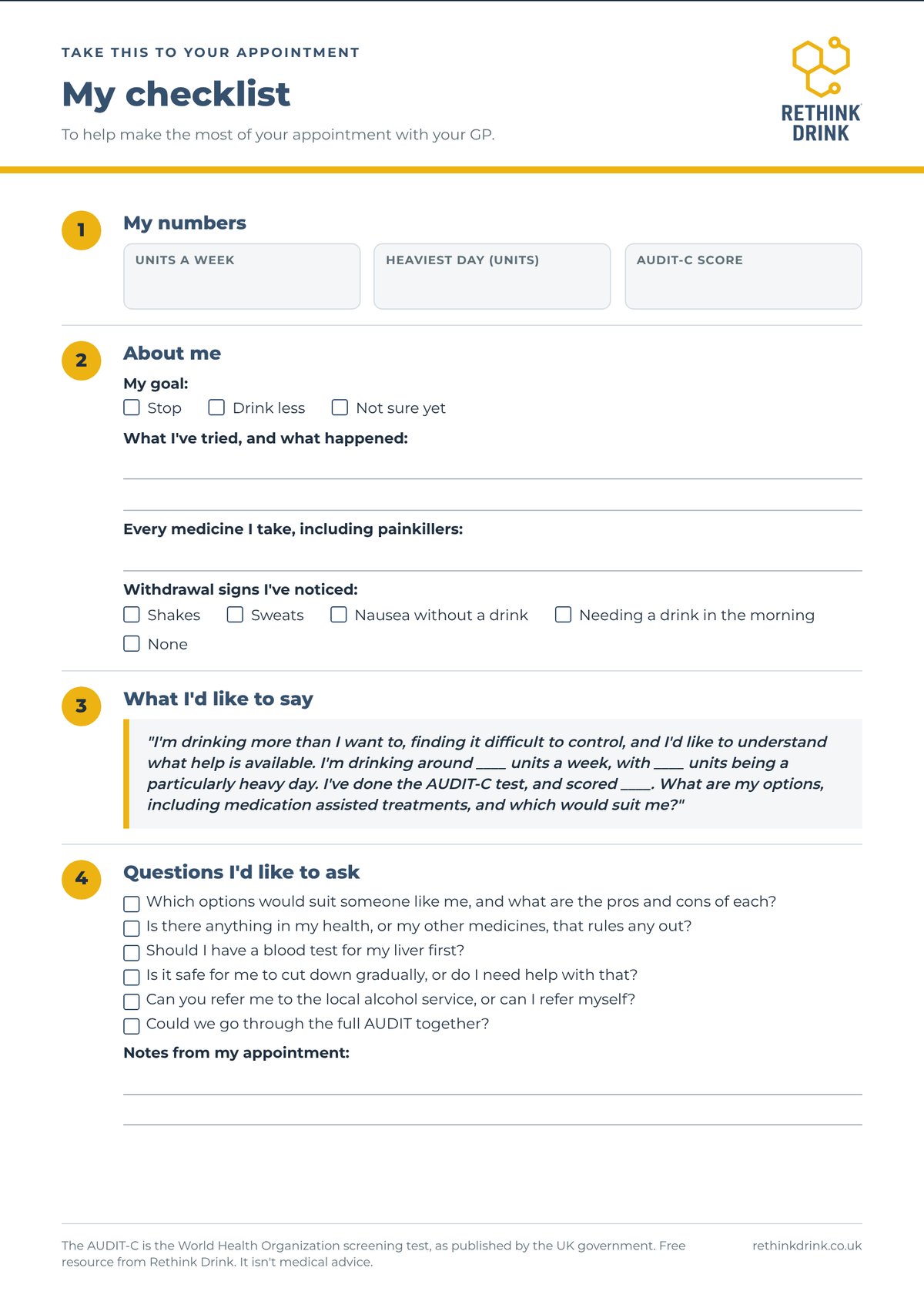
Download the printable checklist (PDF, free)
1. Know your numbers
Your drinking, honestly. A typical week in units. Our units calculator works it out for you.
Your AUDIT-C score. Three quick questions from the World Health Organization's AUDIT, and the same short check many GPs use. Ours is just below the units calculator. Do it first and you walk in with a score.
...The full AUDIT is 10 questions. You can do it on GOV.UK if you want to, or leave it for a conversation with your GP. Going through it together will help them understand your situation.
2. Write it down
What you've tried, and what happened.
Your goal: cutting down, stopping, or not sure yet.
Every medicine you take, including painkillers. Some medicines for alcohol don't mix with opioid painkillers like codeine or tramadol, so your GP needs the full list.
Any withdrawal signs: shakes, sweats or nausea without a drink, or needing a drink in the morning.
3. Say it plainly
You don't need the perfect words. Something like this is enough:
"I'm drinking more than I want to, finding it difficult to control, and I'd like to understand what help is available. I'm drinking around ____ units a week, with ____ units being a particularly heavy day. I've done the AUDIT-C test, and scored ____. What are my options, including medication assisted treatments, and which would suit me?"
It tells your GP you're serious and you've done your homework. And it asks for their judgement, rather than a prescription.
...Want to ask about a specific medicine, like naltrexone? Name it, and ask which way they'd use it. One medicine, two methods.
4. Questions worth asking
Which options would suit someone like me, and what are the pros and cons of each?
Is there anything in my health, or my other medicines, that rules any out?
Should I have a blood test for my liver first?
Is it safe for me to cut down gradually, or do I need help with that?
Can you refer me to the local alcohol service, or can I refer myself?
Could we go through the full AUDIT together?
Your checklist (screenshot this)
My units a week: ____ Heaviest day: ____ AUDIT-C score: ____
My goal: stop / drink less / not sure yet
Medicines I take (including painkillers): ____
I'd like to talk about: my options, including medication assisted treatments; any blood tests; a referral to local support
The worries people don't say out loud
Most people put this appointment off because of what might happen afterwards. Here are the honest answers.
Will it go on my medical record?
Usually, yes. What you discuss with your GP is recorded, like any health problem. Your record is confidential: your GP can't share it with your employer or anyone else without your consent, except in rare cases where someone is at serious risk. You can see your own GP record, and most practices let you view it in the NHS App.
Will it affect insurance?
It can. When you apply for life, health or income protection insurance, the law says you must take reasonable care to answer the insurer's questions truthfully. Many ask whether you've ever been advised to cut down. That covers any advice or treatment, NHS or private: going private doesn't change what you need to tell an insurer. If an insurer asks your GP for a report, the Access to Medical Reports Act 1988 gives you the right to see it first.
Do I have to tell the DVLA?
Possibly. The rules are set by the DVLA, not your GP. GOV.UK says you must tell the DVLA if you have an alcohol problem, and you can be fined up to £1,000 if you don't. It's your responsibility, not your doctor's. If a doctor believes you're driving when it isn't safe and you won't tell the DVLA, the GMC allows them to, after talking to you first.
The honest bottom line
Getting help, however you get it, doesn't change those duties.
What it does change is the direction your life is going in.
A note on your record that you asked for help is the start of a good story. Not a bad one.
What if my GP says no?
It happens a lot. And it's usually down to the reasons above, not you.
It isn't the end of the road... You've already done the hardest part: you asked. And better than that, you now have some knowledge and perspective on your situation.
There are real next steps, and most people don't know about them. I've put them all in one place: My GP said no. What now?
And whatever happens, you can talk to someone today. Drinkline, the national alcohol helpline, is free and confidential: 0300 123 1110.
Why is a prescription only the start?
However you get it, from your GP, the NHS or privately, a prescription is the beginning. Not the end.
The NHS already works this way. Its naltrexone comes with a treatment plan and support, usually from your local specialist service. The medicine is never meant to work alone.
The Sinclair Method is no different. In the trials, support was the common thread.
In the key Finnish trial, naltrexone made the biggest difference for people who also had coping-skills sessions: 27% had no return to heavy drinking over 32 weeks, against 3% on a placebo. For people given only general support, naltrexone didn't beat the placebo at all (Heinälä and colleagues, 2001).
Read that again... Same medicine. Different support. Different result.
And The Sinclair Method asks something the NHS route doesn't: you keep drinking while it works. Your drinking comes down over months, and someone needs eyes and ears on how that's going. That's the gap a ten-minute GP appointment can't fill.
It's the gap we built Rethink Drink to fill.
Over time, the medicine can quieten the desire...
But, the Friday nights, the stress, the routines you've built around a drink over years... That's the work. And it's where support makes the difference.
We're open about the evidence, including what it can't tell you. Even our own famous 78% figure. Here's what the research really shows.
Read next: Naltrexone for alcohol in the UK: what it is and how it works; Does naltrexone block all pleasure?; No willpower to stop drinking?
Common questions
Will my GP prescribe naltrexone for The Sinclair Method?
Possibly, but it's uncommon. It's outside UK guidelines and its licence, so most GPs won't. It's still worth asking.
Can my GP refuse to prescribe naltrexone?
Yes. Prescribing is your GP's decision. If they say no, ask what they'd suggest instead and whether they'll refer you.
Do I have to stop drinking before I can get naltrexone?
For its usual NHS use, usually yes. The Sinclair Method doesn't ask you to stop first. Either way, if your body depends on alcohol, a doctor needs to look at that first.
Will my GP take over a private prescription?
Sometimes. Some GPs will continue a medicine another doctor started, but they don't have to.
My GP had never heard of The Sinclair Method. Is it real?
Yes. It's based on decades of research by Dr David Sinclair, and naltrexone is a licensed UK medicine. Using it The Sinclair Method way is off-label and not part of UK guidelines, which is why many GPs haven't come across it. What the research really shows.
If you'd like support from us
Rethink Drink is a UK coaching service built around The Sinclair Method. Our programmes include a consultation with an independent prescriber, who decides whether treatment is suitable. Clinical oversight is provided by consultant psychiatrist Professor Jonathan Chick. Any prescription is dispensed by an independent partner pharmacy. Our coaches work with you, week by week, on everything around it.
Please look after yourself
This page is here to help you understand your options. It isn't medical advice, and it can't replace a conversation with a doctor who can ask qualifying questions.
Before you change how much you drink or start any medication, speak to your GP or a prescriber.
I really hope this post helps. If you have any questions, you can contact me here.
Matt
Sources
Department of Health and Social Care. UK clinical guidelines for alcohol treatment, chapter 10: pharmacological interventions.
NHS. Alcohol use disorder.
General Medical Council. Prescribing unlicensed medicines.
NHS North East London. Medicine supply notification MSN/2024/087. August 2024.
Derbyshire Joint Area Prescribing Committee. Shared care guideline: naltrexone for alcohol.
Bennett Institute, University of Oxford. OpenPrescribing (NHS England prescribing data, August 2025 to July 2026).
Heinälä P and colleagues. Targeted use of naltrexone without prior detoxification in the treatment of alcohol dependence. Journal of Clinical Psychopharmacology, 2001.
GOV.UK. Alcohol use screening tests (AUDIT).
GOV.UK. Alcohol problems and driving.